AI Agents Can Now Buy Computing With Bitcoin—Does Lightning Have Its Use Case?
Lightning Labs’ pi402 lets coding agents pay for AI inference with Bitcoin. The launch tests whether tiny automated payments can solve a real computing business problem.
AI agents have a new way to spend Bitcoin: buying the computing needed to keep working. Lightning Labs has launched pi402, a tool that lets coding agents pay for AI inference over the Lightning Network.
The November 12 announcement moves the agent-payments debate toward a specific purchase. Rather than imagining software shopping autonomously for everything, it starts with a recurring need: access to an AI model that can process the next prompt.
“Inference is the fuel every agent runs on,” Lightning Labs’ Olaoluwa Osuntokun wrote. The business question is whether a Bitcoin payment can make that fuel easier to buy and sell.
How AI agents use Bitcoin for inference
Pi402 connects the Pi coding-agent environment with paid inference services. The launch describes an embedded Wavelength wallet and controls for per-request spending and daily budgets. A human still funds the wallet and sets the operating boundaries.
The attraction is access without creating a separate buyer account or supplying a card to each participating seller. That does not make the entire AI service anonymous, unregulated or free of provider conditions. It changes the payment and access mechanism for services that implement it.
According to the L402 documentation, a buyer first requests a protected resource. The server returns a payment-required response, a credential and a Lightning invoice. Paying produces proof that can be presented with the credential to gain access.
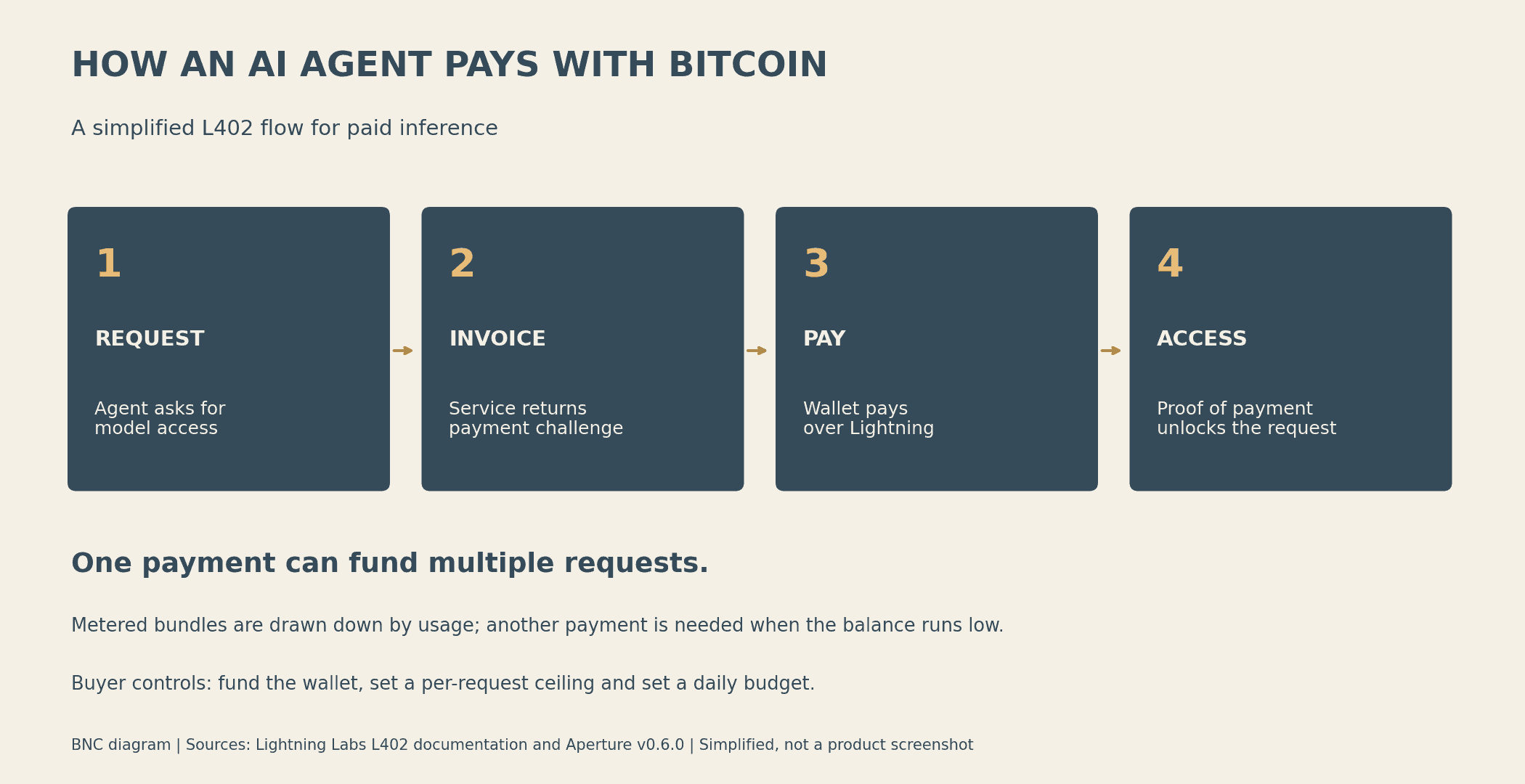
The payment becomes part of authorisation rather than an invoice to settle later. The documentation also describes restricting and delegating bearer credentials, which matters when one piece of software needs to give another a limited ability to buy or access resources.
The useful detail is metering, not a payment for every word
The Aperture v0.6.0 release notes describe prepaid bundles that are drawn down according to actual usage. A single Lightning payment can therefore support multiple model requests. The system does not need to initiate a separate payment for every generated token.
The proxy obtains a price, reserves an estimated amount for a request and accounts for the reported usage afterward. When the remaining balance cannot cover another request, it can issue a new payment challenge.
That distinction separates a plausible billing system from a flashy demonstration. Model responses vary in length. Sellers need a way to price that uncertainty, and buyers need to see what they have actually consumed.
The same release supports both L402 and the Payment HTTP Authentication Scheme used by the Machine Payments Protocol. Supporting more than one payment-authentication format could help services meet different clients, although compatibility by itself does not establish commercial adoption.
The seller still has costs, accounts and exchange-rate exposure
Lightning Labs’ public Lightmeter repository shows another important layer. It converts a provider’s dollar-denominated model prices into millisatoshis per token, can add a seller margin and reconciles usage against the provider’s billing records.
A millisatoshi is one-thousandth of a satoshi. That granularity allows small accounting units, but the conversion does not make the underlying computing free or ensure that Bitcoin-denominated prices stay constant.
The repository’s architecture places the upstream provider’s API key at the proxy. In other words, removing an API key from the buyer’s experience does not necessarily remove API keys from the supply chain. Someone still needs to secure the provider relationship and pay its bill.
That gives the story a more grounded commercial angle. A reseller could offer a narrow, paid entry point to computing while managing procurement and billing behind it. Whether that arrangement is attractive depends on price, reliability, model access and the terms of the upstream service.
Why irreversible payments are a trade-off
Osuntokun argues that card chargebacks are poorly matched to computing that has already been consumed. A completed response cannot be ungenerated so that a seller can recover the electricity and GPU time.
Final payment can reduce that particular uncertainty for a seller. For a buyer, however, it raises the importance of spending controls and service quality. Paying successfully establishes access; it does not prove that an answer is correct or that an autonomous workflow was worth its cost.
BNC’s coverage of Claude Fable and Mythos 5.2 examined falling model prices alongside the continuing need for human judgment. Automating payment makes that distinction more consequential: a system can spend efficiently while pursuing an unhelpful task.
The adoption test starts with something measurable
The launch supplies software and an identifiable use case, rather than evidence that a large new market already exists. The announcement does not establish independent transaction volume, recurring demand or a broad network of competing sellers.
Useful follow-up evidence would include repeat purchases, the number of active providers, total payment costs and how often spending limits prevent unwanted work. Those measures would help distinguish a convenient developer tool from a meaningful new source of Lightning usage.
For Bitcoin, the opportunity is straightforward: a machine-native service being bought through a machine-readable payment. Pi402 makes that proposition testable. Its success will depend on whether developers keep choosing it after the novelty of an agent with a wallet has worn off.
 Brave New Coin reaches 1M+ engaged crypto enthusiasts a month through our website, podcast, newsletters, and YouTube. Get your brand in front of key decision-makers and early adopters in 2026. Limited slots remaining! Find out more today!