Bitcoin Faces CPI Test After AI Stock Sell-Off

Bitcoin faces October’s U.S. inflation report after the AI stock sell-off, with Tuesday’s CPI release and CoreWeave results testing appetite for risk.
Bitcoin faces a fresh inflation test on November 10 after an AI-led sell-off exposed how quickly pressure in technology stocks can spill into crypto. The next question is whether U.S. price data will ease interest-rate concerns or give investors another reason to retreat from risk.
The Bureau of Labor Statistics will release October’s consumer price index at 8:30 a.m. Eastern Time on Tuesday. Later that day, AI cloud provider CoreWeave reports quarterly results, putting monetary policy and the economics of the AI boom in focus within hours of each other.
AI stock losses put Bitcoin’s recovery under pressure
The setup follows a sharp reversal in sentiment. In its November 6 market update, CoinShares said the previous day’s trading saw the Nasdaq fall 5.5%, the Nasdaq-100 lose 6.4% and semiconductor stocks drop 12%, while Bitcoin declined just over 5%.
More than $1 billion in leveraged crypto positions were liquidated during the sell-off, according to the update. Bitcoin miners with growing exposure to AI and data centres were particularly vulnerable, illustrating how diversification into computing infrastructure can also tie their fortunes more closely to technology stocks.
CoinShares’ head of research, James Butterfill, argued that interest rates and liquidity remained central to Bitcoin’s outlook following the U.S. midterm elections.
“The election changes the political backdrop, but the Fed still holds the more important cards,” he wrote.
The Bitcoin CPI test: look beyond the headline number
The inflation backdrop is already uncomfortable. The September CPI report showed consumer prices rising 0.6% over the month and 3.7% over the year. Gasoline prices jumped 9.1%, accounting for more than half the monthly headline increase.
Core CPI, which excludes food and energy, rose 0.3% month-on-month and 2.6% year-on-year. That distinction matters for Tuesday: a slowdown driven mainly by cheaper energy would offer different information from a broader cooling in underlying prices.
Investors will therefore need to examine the monthly core reading and the composition of inflation, alongside the annual headline rate. Comparing the release with market expectations will be more informative than treating any decline from September as an automatic signal to buy.
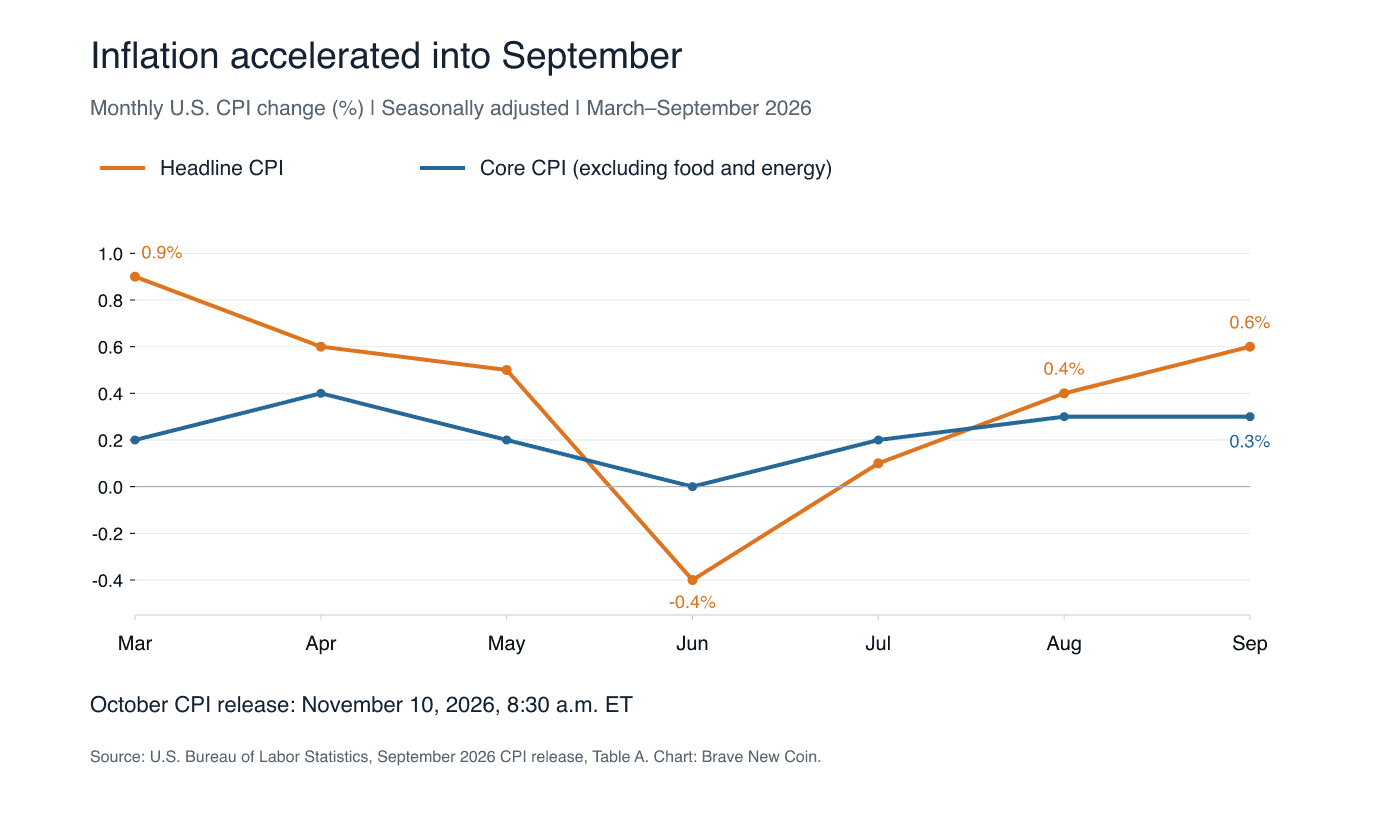
Monthly U.S. headline and core CPI changes, seasonally adjusted, March–September 2026. Source: U.S. Bureau of Labor Statistics, Table A. Chart: Brave New Coin.
The October numbers are not available yet. The chart shows the published historical backdrop, including the renewed acceleration in monthly headline inflation through August and September.
The Fed has already signalled caution
The Federal Reserve held its policy rate at 3.75%–4% on October 28, but the decision was not unanimous. Two officials preferred a quarter-point increase.
“Inflation remains elevated,” the committee said, adding that further information would help determine the appropriate policy stance.
The labour market has since added another consideration. The October employment report, released November 6, showed payrolls increasing by 165,000 and unemployment at 4.1%. Those figures give policymakers fresh evidence to weigh alongside inflation before their December 8–9 meeting.
What hotter or cooler inflation could mean for Bitcoin
A stronger-than-expected inflation reading could reinforce expectations of tighter policy. If Treasury yields and the dollar rise in response, Bitcoin could face renewed pressure as investors reassess the appeal of holding riskier assets.
A softer report, especially one showing less persistent core inflation, could support the opposite reaction. Lower rate expectations could improve the conditions for a recovery in crypto and technology shares.
Neither outcome guarantees a particular Bitcoin price move. These are scenarios for interpreting the release, and positioning matters: an apparently favourable number can produce a muted response if traders have already anticipated it.
The useful confirmation would come from several markets moving together. A Bitcoin rebound accompanied by easing bond yields and firmer technology stocks would tell a different story from a brief crypto spike that fades while financial conditions remain tight.
CoreWeave adds a second test for the AI trade
Inflation is only the first event on Tuesday’s calendar. CoreWeave has scheduled its third-quarter earnings call for 5 p.m. Eastern Time on November 10.
Its results and commentary could offer another window into AI infrastructure demand, financing needs and the pace of data-centre expansion. One company cannot settle the wider debate over AI valuations, but the timing gives investors a separate source of information after the inflation report.
That matters for Bitcoin because last week’s selling showed that crypto can be caught in a wider reduction in risk exposure, even when the immediate concerns originate outside digital assets.
What to watch after the release
Brave New Coin’s recent Bitcoin market analysis identified the $73,000 region as an important downside reference and $79,000–$80,000 as an area of resistance. Those are reference levels from that analysis, rather than forecasts of where CPI will send the market.
Tuesday’s immediate test is whether inflation changes the interest-rate outlook enough to shift risk appetite. The stronger signal will be whether Bitcoin can sustain its response once the first burst of volatility passes—and whether the AI earnings news reinforces or challenges that move.
 Brave New Coin reaches 1M+ engaged crypto enthusiasts a month through our website, podcast, newsletters, and YouTube. Get your brand in front of key decision-makers and early adopters in 2026. Limited slots remaining! Find out more today!