Google Launches Gemini 4 Carbon as Its Strongest Model for Autonomous AI Agents
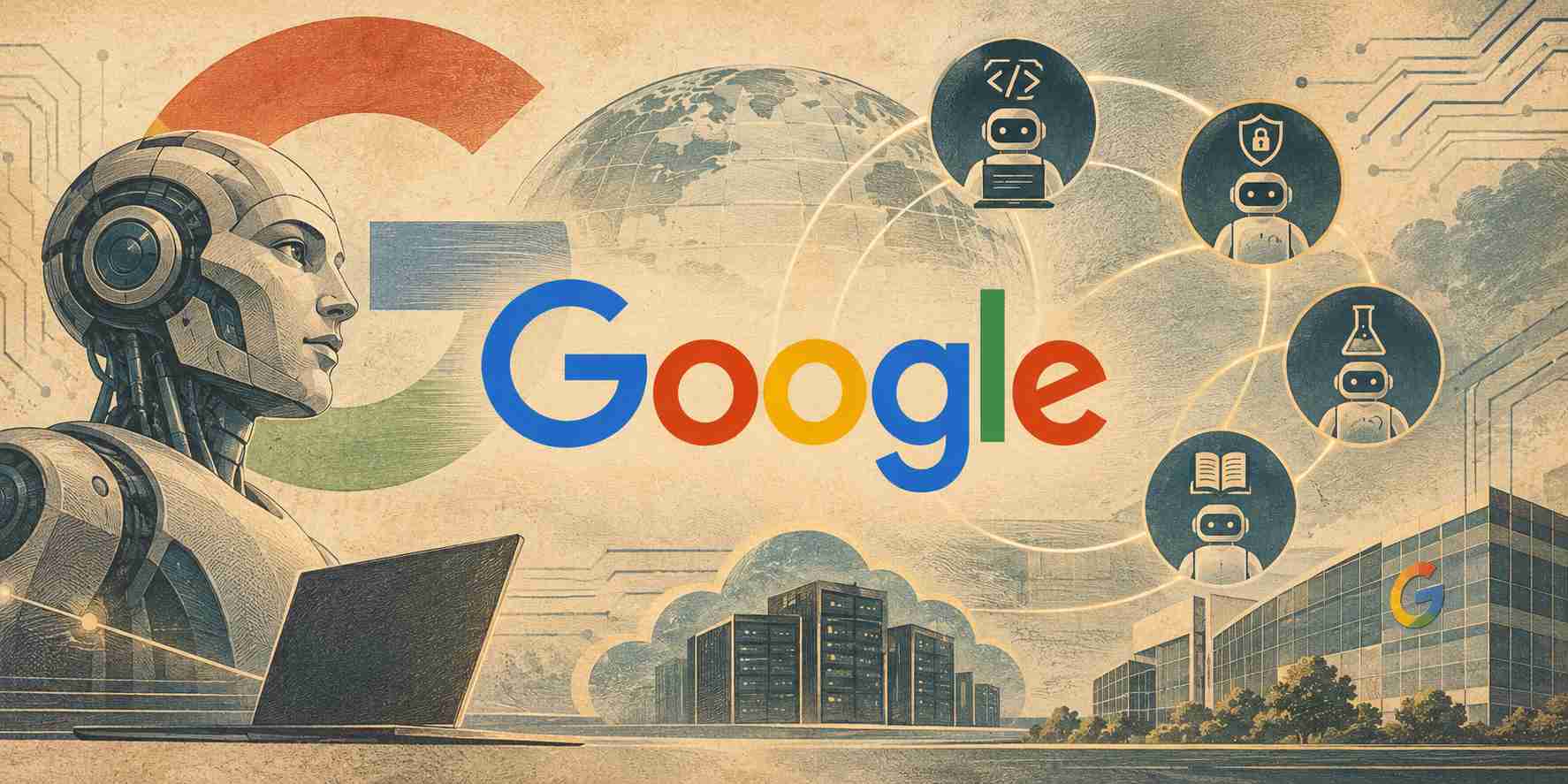
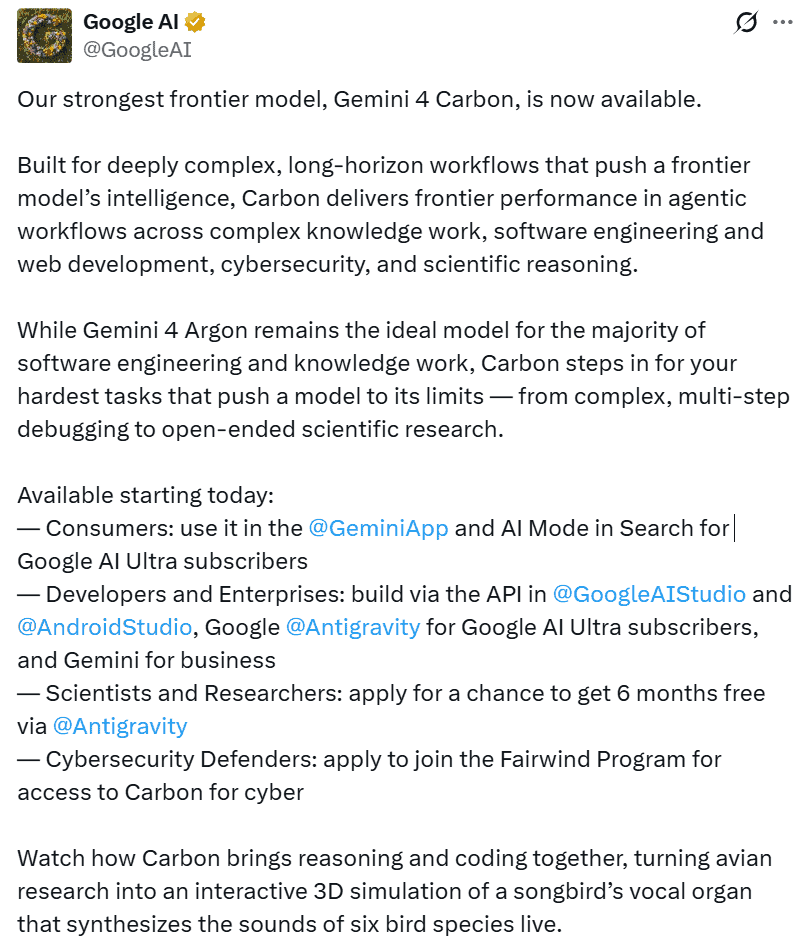
Google has begun a wider rollout of Gemini 4 Carbon, a frontier AI model designed to handle complex agentic workflows that require sustained reasoning and repeated verification.
The release expands access to Google’s most capable model for demanding software engineering, cybersecurity, scientific research, and knowledge work. It also introduces a new multi-agent coordination feature in Google Antigravity, allowing specialized AI agents to work together on complex projects.
Gemini 4 Carbon Targets Complex Agentic Workflows
Google DeepMind describes Gemini 4 Carbon as its strongest model for long-horizon tasks, where completing a request requires multiple stages of planning, execution, testing, and refinement. Unlike conventional AI assistants that primarily respond to individual prompts, Carbon is designed to maintain context across extended workflows and verify its work before producing a final result.
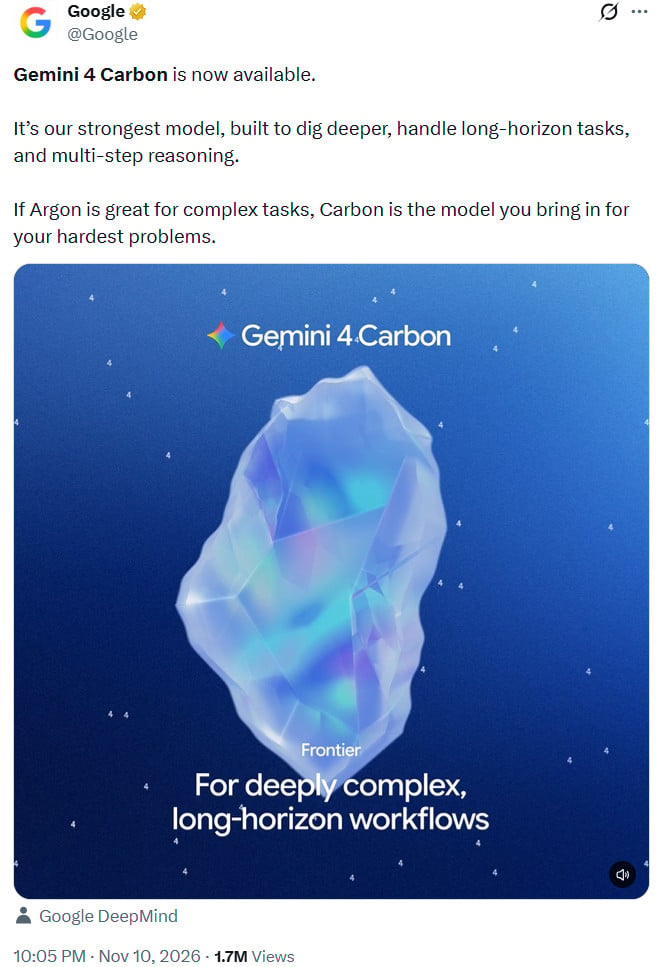
Google unveils Gemini 4 Carbon, its most powerful model yet, designed for complex workflows and advanced multi-step reasoning. Source: Google via X
Koray Kavukcuoglu, senior vice president of Google DeepMind and Google’s chief AI architect, described Carbon as the company’s “strongest model with frontier performance in cybersecurity capabilities and long-horizon agentic workflows.”
The model builds on Gemini 4 Argon but uses more reasoning tokens to investigate problems, evaluate possible solutions, and perform additional verification rounds. Google says this approach makes Carbon better suited to complex coding and debugging, open-ended scientific research, and engineering projects that require coordination across multiple tools.
However, Google maintains that Argon remains a suitable choice for most software engineering and knowledge-work applications. Carbon is intended for more demanding assignments where deeper reasoning and additional verification can justify higher computational requirements.
Gemini 4 Carbon also supports multimodal inputs, including text, images, audio, and video. According to its technical model card, the model has a combined input-output context window of up to one million tokens, allowing it to process extensive information within a single workflow.
Google Antigravity Introduces the /swarm Multi-Agent Feature
A central part of the release is Google’s preview of the /swarm feature in Antigravity, its agent-focused development platform. The feature allows users to turn a single prompt into a coordinated team of specialized AI agents that can divide work, execute tasks simultaneously, and review one another’s output.
Gemini 4 Carbon outperforms Argon on demanding benchmarks, including coding, cybersecurity, and financial tasks, through deeper reasoning and enhanced verification. Source: Google AI via X
The system uses a coordinating agent to distribute responsibilities among parallel workers operating in isolated Git workspaces. Additional verification agents can run tests, inspect proposed changes, and identify potential problems before the work is completed.
Google Antigravity describes the approach as a system in which agents “plan, build, and verify in parallel.” A shared message board and dedicated interface allow developers to monitor the team’s progress, inspect individual agents, and intervene when necessary.
Google demonstrated the system by creating an interactive 3D exhibition of the Eiffel Tower’s construction between 1887 and 1889. Using historical photographs and engineering drawings as references, a team of Gemini 4 Carbon agents generated a Three.js experience that presented the structure’s development through an interactive visualization.
The demonstration highlights Google’s focus on tasks that extend beyond generating code snippets or answering technical questions. Carbon can coordinate multiple stages of development, including building assets, integrating components, testing functionality, and refining the final application.
The /swarm preview is rolling out across the Antigravity application and command-line interface. Google also allows different models to handle different responsibilities, enabling Carbon to perform demanding architectural planning and auditing while faster models manage routine implementation work.
Benchmark Results Highlight Coding, Cybersecurity, and Scientific Reasoning
Google’s published evaluations indicate improvements across several areas of AI performance, particularly agentic coding, cybersecurity, and complex knowledge work.
The company reports that Gemini 4 Carbon ranks first on CursorBench 4.0, Perplexity’s WANDR, and Zapier’s AutomationBench. Google also says the model achieves more than twice the cost efficiency per task compared with the next-best external model across these evaluations.
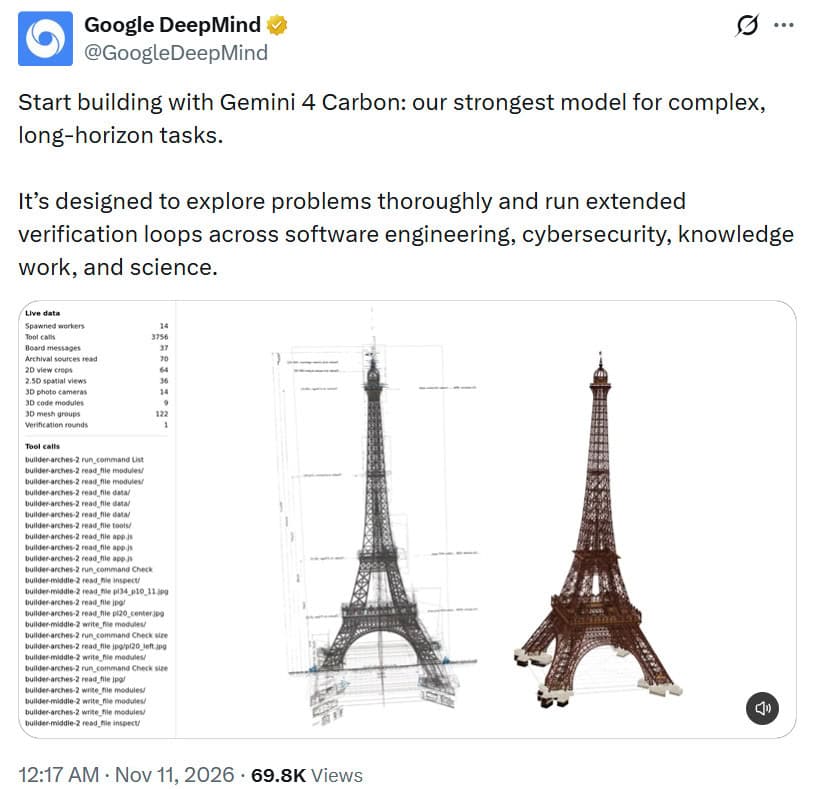
Gemini 4 Carbon is Google’s strongest model, built for complex, long-horizon tasks across software engineering, cybersecurity, science, and knowledge work. Source: Google DeepMind via X
A separate assessment focuses on the Multimodal Knowledge Agent (MKA) benchmark, developed in partnership with Artificial Analysis. The evaluation examines how AI agents process visually complex information, including charts, engineering diagrams, spreadsheets, and documents, before producing professional work.
The benchmark contains 200 tasks developed with domain experts across 10 industries and 83 occupations. Each assignment represents a multi-step project designed to reflect work that could take an experienced professional between three and eight hours to complete.
Gemini 4 Carbon ranked second in overall quality in the MKA evaluation while completing tasks at approximately one-sixth of the average cost of the highest-scoring model. The result highlights its ability to balance output quality with the computational expenses associated with complex AI workflows.
Cybersecurity is another important focus of the release. Google’s model card reports scores of 88.2% on SEC-bench Pro, 54.8% on ExploitGym, and 71% on CWE-bench. These evaluations cover different stages of vulnerability discovery, exploitation, and patching.
Google initially restricted access to Carbon’s specialized cybersecurity capabilities through its Fairwind Program, which provides access to verified security defenders. The company says this approach supports defensive research while maintaining safeguards against potential misuse.
Despite these improvements, Google acknowledges that protection against sophisticated prompt-injection attacks remains an area requiring continued development. The company says it is expanding automated security testing and strengthening safeguards alongside the model’s capabilities.
Gemini 4 Carbon Availability and Pricing
Gemini 4 Carbon became available more broadly on November 10, following its initial announcement on October 28 and an earlier limited rollout to cybersecurity defenders.
Developers can access the model through the paid Gemini API tier in Google AI Studio and Android Studio. Enterprise customers can use it through Gemini for business, while Google AI Ultra subscribers are receiving access through the Gemini app, Google Antigravity, and AI Mode in Search.
Google is also expanding access for scientific research. Eligible researchers can apply to use Carbon and Argon through Antigravity’s highest usage tier without charge for six months, subject to selection, capacity, and program requirements.
For API customers, Google has introduced an initial pricing structure of $2 per million input tokens and $10 per million output tokens, matching the introductory rates previously offered for Gemini 4 Argon. These rates remain in effect through November 30, 2026, before increasing to $4 per million input tokens and $20 per million output tokens from December 1.
The launch positions Gemini 4 Carbon as a specialized option for developers, businesses, and researchers working on complex projects that demand sustained AI reasoning and coordinated execution. With the addition of /swarm, Google is also extending its development platform toward multi-agent systems in which multiple AI models can collaborate on larger assignments rather than relying on a single agent to complete every step.
 Brave New Coin reaches 1M+ engaged crypto enthusiasts a month through our website, podcast, newsletters, and YouTube. Get your brand in front of key decision-makers and early adopters in 2026. Limited slots remaining! Find out more today!