Microsoft Faces AI Backlash as 100+ Protesters Break Into $1B Amsterdam Data Center Project

More than 100 activists broke into a Microsoft-linked data center construction site in Amsterdam on November 6, climbing cranes and displaying banners against the expansion of artificial intelligence infrastructure.
The demonstration brought together environmental campaigners and other protest groups concerned about the industry’s growing demand for electricity, water, and land. Police intervened and detained between 150 and 200 people on suspicion of trespassing, according to Dutch authorities.
Protesters Target Microsoft Data Center Construction Site
The demonstration took place at a construction site in Amsterdam’s Westpoort district, where Pure Data Centers is developing a facility intended for Microsoft. Members of the Dutch activist group Geef Tegengas entered the site, climbed construction structures and a crane, and displayed banners criticizing artificial intelligence and Microsoft’s business activities.
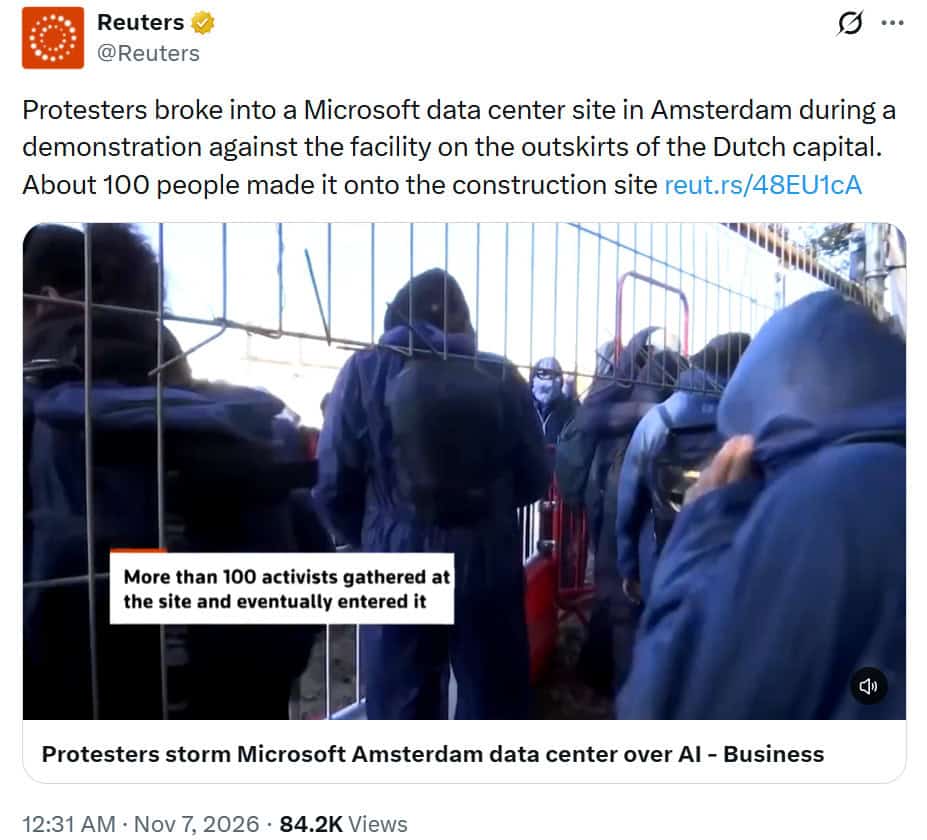
Reuters footage shows around 100 activists breaching a Microsoft data center construction site near Amsterdam on November 6, 2026, protesting the facility’s development. Source: Reuters via X
Footage from the scene showed protesters scaling fences, gathering around construction equipment, and displaying messages including “Fuck AI” and “Microsoft Powered Genocide.” Some demonstrators also set off flares and spray-painted slogans around the site. The action drew attention to both the environmental impact of data center expansion and concerns about the use of Microsoft’s technology in military and surveillance operations.
Sam van der Beek, a protester involved in the demonstration, told Reuters that data centers were “destroying our world” because of the resources they consume. He added that the growing environmental burden was making the planet increasingly difficult to inhabit.
The protest also involved groups opposing Microsoft’s connections to military and government surveillance operations. Demonstrators displayed Palestinian flags and banners criticizing the company’s services to the Israeli military and the US Immigration and Customs Enforcement agency. These concerns added a human rights dimension to the wider opposition against AI infrastructure.
Police moved to clear the construction site as tensions increased. The Associated Press reported that some activists clashed with officers, while DutchNews reported the use of pepper spray. Dutch police later confirmed that between 150 and 200 people had been detained on suspicion of trespassing. An officer also sustained a minor injury during the demonstration, according to a police statement reported by The Guardian.
Energy and Water Consumption Drive Opposition
Environmental concerns remain at the center of the growing resistance to AI data centers across Europe. Campaigners argue that facilities supporting cloud computing and artificial intelligence require substantial electricity, cooling resources, and land, potentially placing additional pressure on communities already dealing with infrastructure constraints.
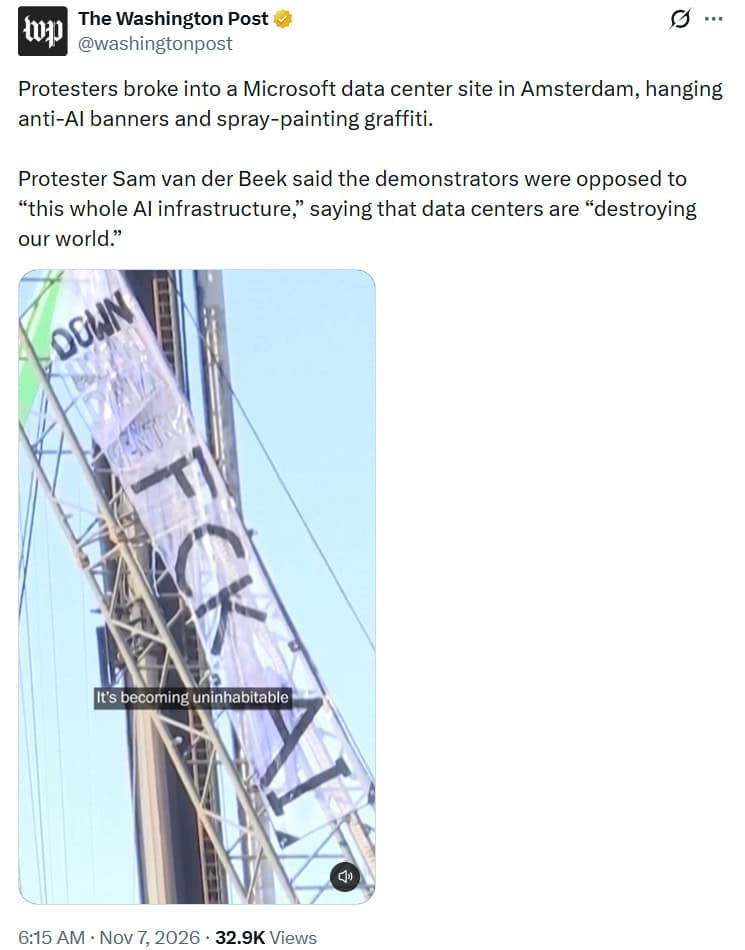
Protester Sam van der Beek criticized data centers for their heavy consumption of water, electricity, and land, while the action formed part of a Europe-wide campaign calling for construction to be halted. Source: The Washington Post via X
The Amsterdam project has attracted particular attention because of its expected electricity demand. According to information published by Pure Data Centers, the Westpoort campus will have three towers with a combined data hall capacity of 78 megawatts (MW). The developer plans to connect the facility to the electricity grid through a dedicated substation.
The project’s scale has raised questions about how new data centers will compete with households, businesses, and other developments for limited power resources. The Netherlands is already dealing with electricity grid congestion, creating challenges for companies seeking new or upgraded connections. Campaigners argue that allocating substantial capacity to AI infrastructure could make it harder to accommodate other local priorities.
Water consumption is another concern. Data centers require cooling systems to maintain operating temperatures, with demand depending on the technology and cooling methods used. Activists fear that a rapid increase in computing facilities could put additional pressure on local water supplies and environmental resources.
The campaign also challenges the concentration of digital infrastructure within a small number of technology companies. Protesters argue that decisions about where facilities are built and how they operate should involve greater public consultation, particularly when local communities may experience the environmental and infrastructure costs.
$1B Microsoft Data Center Project Raises Regulatory Questions
Pure Data Centers plans to invest more than €1 billion in the Amsterdam Westpoort campus, which is fully leased to Microsoft. The development will consist of three towers, each approximately 85 meters tall, across a site covering around six acres.
The developer estimates that construction and related activities will directly provide more than 1,000 jobs. Once operational, the campus is expected to support approximately 80 permanent positions involving engineering, maintenance, security, and administration.
Electricity requirements remain a central issue in the debate. A Dutch government response to parliamentary questions published in April 2026 stated that the project’s grid connection capacity would reach 99 MW, based on 33 MW for each tower. The government calculated that continuous electricity demand at that level would amount to approximately 0.87 terawatt-hours (TWh) annually.
That figure represents a theoretical calculation based on continuous full-capacity consumption rather than verified annual usage. The distinction is important when assessing the project’s expected impact on the local power network.
The government also noted that the development would not use groundwater following discussions with the developer. The project was also designed to transfer heat to a planned heating facility across the street, providing a potential use for some of the heat generated during operations.
Amsterdam Data Center Restrictions and Project Approval
The development has also drawn scrutiny because Amsterdam has introduced restrictions on new data center construction. In April 2025, the city barred new data centers and expansions within the municipality until at least 2030, citing concerns over electricity demand and the pressure placed on local resources.
However, the Microsoft-linked project has a longer regulatory history. According to the Dutch government’s response to parliamentary questions, the original building permit was requested in December 2019 and granted on November 6, 2020, before the national restrictions on hyperscale data centers took effect.
The national rules, introduced in January 2024, restrict new hyperscale facilities based on specific size and electricity connection thresholds. The government’s definition covers projects with more than 10 hectares of built floor space and an electricity connection capacity of at least 70 MW.
Officials said the Amsterdam development does not fall within that legal definition because its built floor area remains below the 10-hectare threshold. The government’s explanation indicates that the project’s earlier approval and legal classification allowed it to proceed despite subsequent restrictions on large-scale data center development.
The regulatory history has not ended public criticism. Environmental organizations and local campaigners continue to question whether existing approval processes adequately account for electricity demand, land use, and the long-term effects of AI infrastructure on surrounding communities.
Microsoft and Pure Data Centers Respond
Microsoft acknowledged the demonstration and defended the right of people to express their concerns peacefully. However, the company opposed the protesters’ entry into the construction site.
“We understand that people feel strongly about the project, and we respect their right to express those views peacefully,” a Microsoft spokesperson said. “However, we do not condone any actions that are unlawful or that put people’s safety at risk.”
Pure Data Centers also called on demonstrators to leave the site safely and offered to discuss their concerns. The company said it remained committed to engaging with local stakeholders and emphasized the importance of maintaining safety at an active construction site.
The developer’s position reflects the wider infrastructure industry’s argument that data centers provide essential computing capacity for businesses, governments, and consumers. Technology companies consider these facilities necessary to support cloud services, AI applications, and the growing demand for digital processing.
European Opposition to AI Data Center Expansion Grows
The Amsterdam demonstration coincided with the November 6-7 European action days organized by the Stop Dirty Data Centres coalition. The campaign brings together environmental organizations, digital rights groups, and community movements calling for a temporary halt to new large-scale data center construction until stronger environmental and regulatory safeguards are established.
Data centers’ water-intensive cooling systems and land-clearing requirements can reduce local freshwater availability and disrupt natural water cycles. Source: Sharon Collins via X
Campaigners organized demonstrations in several countries, including Germany, Poland, Ireland, Italy, and the United Kingdom. Their demands include greater transparency, more public involvement in planning decisions, and clearer requirements for electricity and water consumption.
The campaign has also highlighted concerns about whether the rapid expansion of AI infrastructure is compatible with Europe’s climate objectives. Data centers are becoming an increasingly important part of the region’s digital economy, but their growing energy requirements have prompted questions about grid capacity and the availability of renewable electricity.
European policymakers face the challenge of expanding computing infrastructure while protecting consumers and local communities from additional environmental and energy pressures. EU technology chief Henna Virkkunen has argued that Europe needs more data centers to develop its own AI capacity while warning that expansion must not drive up electricity bills, increase the risk of power shortages, or damage the environment.
The Amsterdam protest illustrates how these competing priorities are becoming increasingly difficult to reconcile. With Microsoft-linked construction continuing despite local opposition, the debate over AI infrastructure is moving beyond technology investment and into questions of environmental responsibility, public oversight, and corporate accountability.
 Brave New Coin reaches 1M+ engaged crypto enthusiasts a month through our website, podcast, newsletters, and YouTube. Get your brand in front of key decision-makers and early adopters in 2026. Limited slots remaining! Find out more today!