Moonshot AI Eyes 8,000+ Nvidia Blackwell GPUs Through European Cloud Providers Despite US Chip Curbs

Moonshot AI is exploring access to more than 8,000 Nvidia Blackwell GPUs in Europe as China’s AI developers seek computing power beyond domestic supply.
CNBC reported on November 5 that the Beijing-based Kimi developer has discussed renting advanced GPU capacity from European cloud operators, although no agreement has been confirmed.
Moonshot AI Seeks More Nvidia Blackwell GPU Capacity
Moonshot AI has reportedly approached European neocloud providers about renting large clusters of Nvidia Blackwell GPUs to expand its computing resources. The discussions involve access to more than 8,000 processors, potentially supporting both AI inference and model training.

Moonshot AI is leasing Nvidia Blackwell GPU clusters from European data centers and cloud providers to secure advanced computing power amid US chip restrictions. Source: CNBC via X
According to CNBC, three people familiar with the discussions said the Chinese AI company has been actively pursuing additional computing capacity in Europe. One source described Moonshot’s efforts as “very aggressive” as it seeks access to Nvidia’s advanced hardware.
The proposed arrangements would allow Moonshot to use computing infrastructure physically located outside China without bringing the restricted processors into the country. Under this model, European data center operators would maintain the hardware while Moonshot would pay for remote access to its computing capacity.
The financial terms could also reflect the regulatory complications surrounding such arrangements. One source told CNBC that a proposal had called for Moonshot to pay an upfront premium of 30% to 50% above the amount charged to a non-Chinese customer. However, the discussions remain preliminary, and there is no confirmation that the company has accepted those terms or secured the capacity.
European Cloud Rentals Raise Questions About US Chip Restrictions
The discussions highlight a gap between restrictions on physical semiconductor shipments and the growing international market for cloud-based AI computing.
Washington has restricted direct exports of Nvidia’s advanced Blackwell processors to Chinese customers over national security concerns. The controls are intended to limit China’s access to high-performance computing hardware that can support advanced AI development.
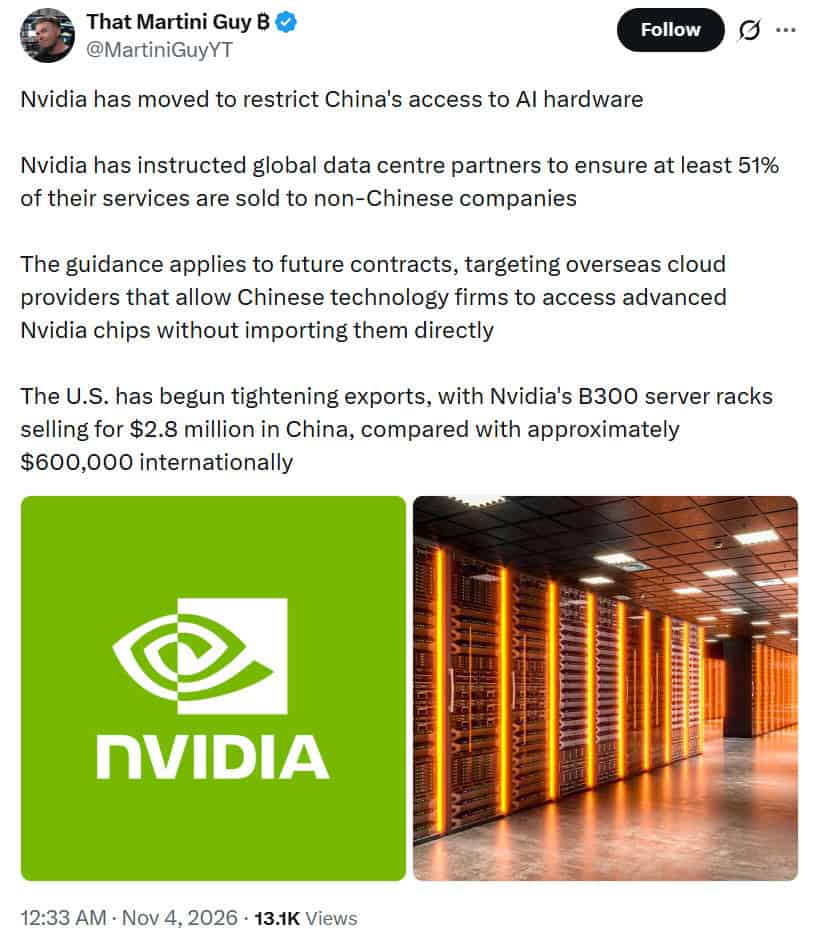
Nvidia requires data center partners to reserve at least 51% of future services for non-Chinese customers to restrict remote GPU access by Chinese firms. Source: @MartiniGuyYT via X
However, renting computing capacity from an independent overseas operator presents a different regulatory question from purchasing restricted chips and transporting them into China. The customer can execute AI workloads remotely while the GPUs remain inside a data center in another country.
This distinction has become a growing concern for US policymakers. A Congressional Research Service report published in April 2026 identified remote access to advanced AI computing through cloud services as a potential weakness in existing export-control enforcement. It noted that foreign AI developers could access advanced processors through cloud providers even when direct hardware shipments were restricted.
Washington has since taken steps to clarify the rules governing overseas chip shipments. On May 31, the US Department of Commerce’s Bureau of Industry and Security clarified that export license requirements also apply to advanced computing chips shipped to companies headquartered in China, even when their receiving entities operate outside the country.
A Reuters report noted that the updated guidance did not require data centers to stop using the chips or discontinue servicing existing equipment. This distinction is important because restrictions on physical exports do not automatically resolve questions surrounding remote access to independently operated computing infrastructure.
The European rental discussions therefore expose an unresolved regulatory challenge. While Washington can restrict the movement and transfer of advanced processors, controlling access to computing services hosted by independent operators in other jurisdictions presents a different enforcement task.
Previous Thailand Access Allegations Put Moonshot Under Scrutiny
Moonshot’s reported European expansion follows an earlier controversy involving Nvidia’s Blackwell hardware in Southeast Asia.
In July 2026, White House Office of Science and Technology Policy Director Michael Kratsios accused the Chinese AI developer of obtaining access to restricted Nvidia processors through facilities in Thailand. The allegation emerged following the release of Moonshot’s Kimi K3 model, which attracted attention for its performance against advanced US AI systems.
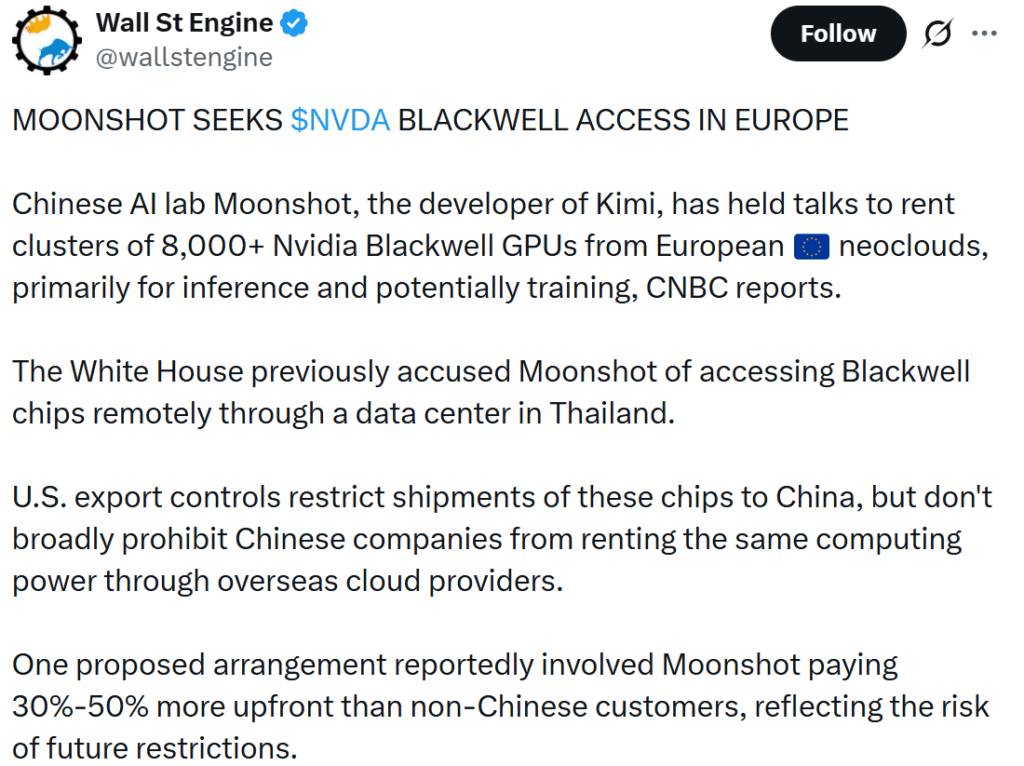
U.S. export controls restrict direct Blackwell chip shipments to China but permit overseas cloud rentals, despite previous White House allegations that Moonshot used a Thailand-based data center. Source: @wallstengine via X
Kratsios said the company had “acquired GB300-equipped servers and has accessed GB300s in Thailand, likely to train its AI models.”
The GB300 is part of Nvidia’s Blackwell generation. The White House’s remarks raised questions about how Chinese AI developers could obtain access to advanced American processors through overseas infrastructure despite Washington’s export restrictions.
The allegation also increased attention on the role of third-party data center operators and international computing providers in the AI hardware supply chain.
Moonshot did not publicly confirm the reported Thailand arrangement in response to the earlier allegations. The latest European discussions indicate that access to overseas computing infrastructure remains an important part of the company’s reported capacity expansion efforts.
Kimi’s Growing Demand Increases Computing Requirements
Moonshot’s interest in additional Nvidia hardware comes as the company expands its AI model development and commercial services.
The startup launched Kimi K3 in July 2026, describing it as a 2.8-trillion-parameter open-weight model designed for advanced reasoning, coding, and knowledge-intensive tasks. Moonshot said the model delivered performance approaching Anthropic’s Fable system, placing its latest release in direct competition with advanced models developed by US technology companies.
The launch also exposed pressure on the company’s existing computing infrastructure. Following a surge in demand, Moonshot temporarily paused new subscriptions to Kimi K3 to prioritize computing resources for existing users.
In a July announcement, the company acknowledged the capacity challenge, stating: “We’re adding capacity as fast as we can and will reopen new subscription spots in batches.”
The situation illustrates why additional inference capacity could be particularly important. Training requires substantial computing resources to develop and improve models, while inference relies on GPUs to process user requests and generate responses after deployment. Growing adoption can therefore increase infrastructure requirements even after a model has completed its initial training.
Moonshot has also been linked to other Nvidia computing arrangements. A July 2026 report by Bloomberg, cited by Reuters, said the company had access to approximately 20,000 Nvidia chips through an agreement with Alibaba. Those processors were reported to belong to Nvidia’s older Hopper generation, although Alibaba disputed claims that it had supplied H200 chips.
The reported discussions with European neocloud operators represent a separate potential source of access to newer Blackwell infrastructure. They could help Moonshot expand its computing resources for both model development and serving users, although the scale of any eventual arrangement remains unknown.
For Nvidia, the reported interest highlights continued demand for its advanced processors across international AI markets, including from developers facing restrictions on direct access to the hardware.
Whether Moonshot secures the proposed European capacity will depend on commercial negotiations, infrastructure availability and the regulatory requirements governing remote access. For now, the discussions offer another indication that competition for advanced AI computing is extending beyond traditional hardware purchases into a global market for rented GPU capacity.
 Brave New Coin reaches 1M+ engaged crypto enthusiasts a month through our website, podcast, newsletters, and YouTube. Get your brand in front of key decision-makers and early adopters in 2026. Limited slots remaining! Find out more today!