OpenAI, Anthropic, and Google DeepMind Join UK’s New AI Biosecurity Mission
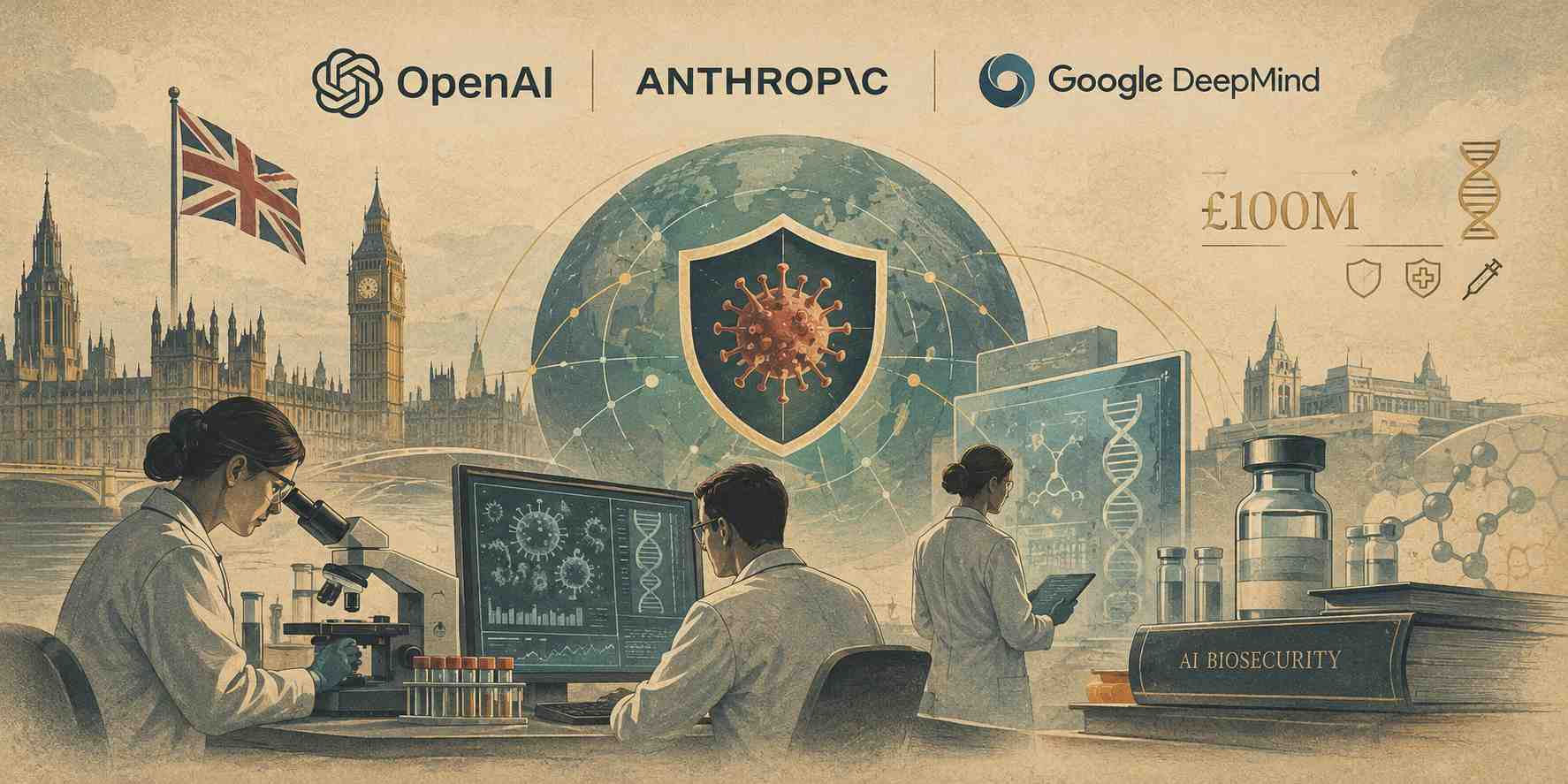
The UK government has launched a £100 million AI Biosecurity Lab, bringing together OpenAI, Anthropic, and Google DeepMind to strengthen defenses against biological threats and improve AI-powered disease detection and medical research.
The initiative forms part of the UK’s National AI Biosecurity Initiative. OpenAI and Anthropic have committed up to £200 million combined in AI model credits, computing resources, and access to advanced systems, while Google DeepMind and Basecamp Research will contribute research collaborations and specialized AI biology tools.
The lab aims to detect emerging biological threats earlier and accelerate the development of vaccines, treatments, and other medical countermeasures. The government describes it as the world’s first dedicated AI biosecurity organization.
UK AI Biosecurity Lab Targets Emerging Biological Threats
The AI Biosecurity Lab (AIBL) will apply advanced AI systems to biological risk assessment, disease surveillance, and emergency preparedness. It will work with government agencies, academic institutions, and life sciences organizations to strengthen the UK’s response to emerging threats.
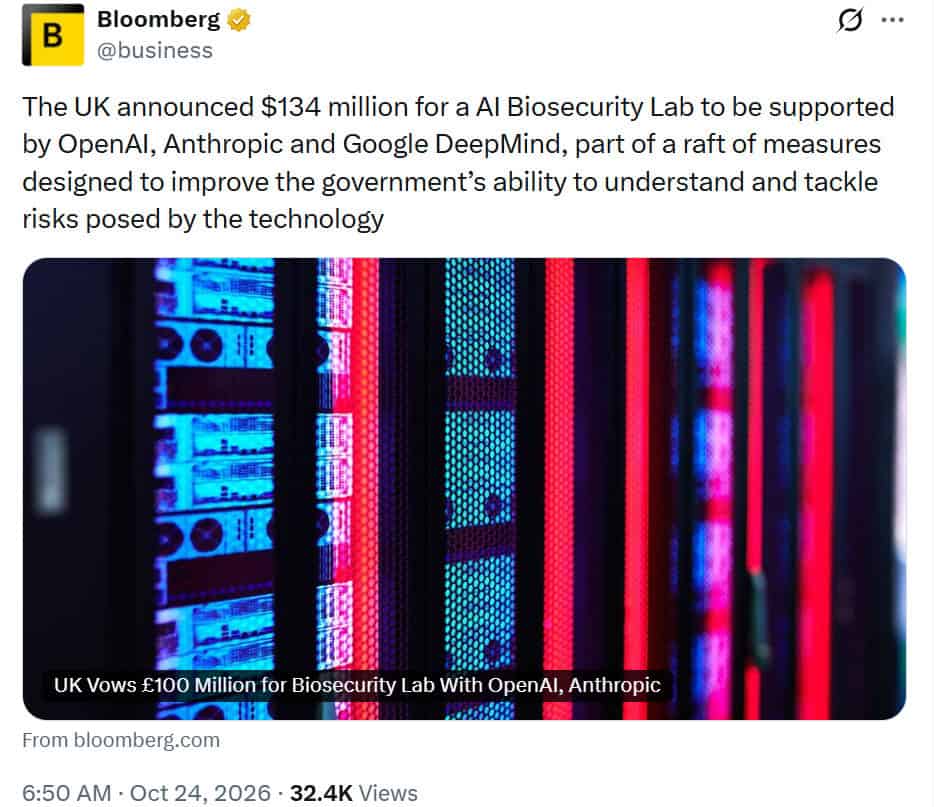
The UK launched a £100 million AI Biosecurity Lab with OpenAI, Anthropic, and Google DeepMind to detect and counter biological threats. Source: Bloomberg via X
AI can accelerate scientific discovery and help researchers identify potential treatments. However, increasingly capable models may also lower barriers to certain forms of harmful biological research, creating additional challenges for public health and national security.
The lab will focus initially on two priorities: improving the early detection of biological threats and accelerating the development and testing of vaccines, treatments, and other medical countermeasures.
Its work will support the UK’s existing biosecurity infrastructure and broader Biological Security Strategy. The aim is to translate advances in AI into practical capabilities that help authorities assess risks and prepare for disease outbreaks.
OpenAI and Anthropic Commit Up to £200 Million
OpenAI and Anthropic have pledged up to £200 million in combined support, primarily through AI model credits, computing resources, trusted access to advanced systems, and technical assistance. These commitments are distinct from direct government funding.
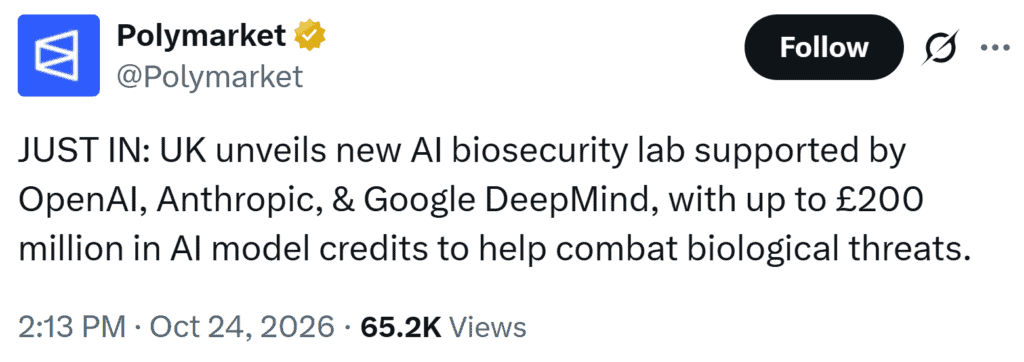
The lab receives £100 million in UK government funding and up to £200 million in AI credits, with support from OpenAI, Anthropic, Google DeepMind, and Basecamp Research. Source: @Polymarket via X
OpenAI’s contribution includes £100 million in computing and model credits, alongside trusted access to relevant advanced models through its Rosalind Biodefense program. Anthropic has pledged up to £100 million in model credits, model access, and dedicated technical support.
The resources are intended to give researchers access to advanced AI capabilities without requiring the lab to finance equivalent computing and model usage independently.
Google DeepMind will contribute through research collaborations involving its scientists and biosecurity experts, while Basecamp Research will provide AI biology models, technical expertise, and related scientific tools.
The partnerships bring together AI developers, biological researchers, and public-sector specialists to develop capabilities for identifying and responding to biological risks.
UK Expands AI Security Investment Beyond Biosecurity
The lab is part of a wider government package addressing AI safety, cybersecurity, and the economic effects of technological change.
The UK has allocated £165 million to its National AI Biosecurity Initiative, including £100 million for the lab and £65 million for pathogen countermeasures. A further £120 million will go to the AI Security Institute to expand its assessment of advanced AI models and emerging risks.

The UK is investing an additional £120 million in the AI Security Institute, £60 million in a National Cyber Shield, and £70 million in a new NERV Centre to strengthen cybersecurity. Source: @KanishkaNarayan via X
The package also includes £60 million for a National Cyber Shield and £70 million for a vulnerability center to strengthen cyber threat detection and identify weaknesses affecting critical systems.
Additional measures target domestic AI development and economic adaptation. These include £60 million in extra funding for the Sovereign AI Fund, £23 million for the AI Economics Institute to examine AI’s effects on jobs and productivity, and £30 million for partnerships with regional mayors to support AI adoption by businesses and public services.
AI Minister Kanishka Narayan has framed the government’s approach around developing safe AI while protecting national security and technological independence.
Independent Organization to Coordinate Research
The AI Biosecurity Lab will operate as an independent, non-profit organization. Its structure is intended to attract specialists from industry and academia while allowing research teams to work at the pace of advanced AI and biotechnology development.
A scientific advisory committee comprising experts from academia, industry, and the third sector will guide its work. The lab will also collaborate with public institutions responsible for health security, animal and plant health, defense research, and medicines regulation.
These partnerships are designed to connect AI research with the organizations responsible for monitoring biological threats, evaluating risks, and coordinating emergency responses. The lab will also work with international partners where appropriate.
AI Biosecurity Becomes a National Security Priority
The initiative reflects a growing challenge for policymakers: AI can accelerate scientific discovery, but its expanding capabilities may also introduce biological risks that require new safeguards.
By combining public funding with access to advanced AI systems and specialist biological research, the UK aims to improve its ability to identify threats and develop countermeasures. The program also links AI safety with broader priorities, including cybersecurity and domestic technology development.
The lab’s effectiveness will depend on whether its research produces reliable, practical tools for public health and security agencies. Detection systems must provide useful warnings, while AI-assisted scientific findings require appropriate testing and validation before they can guide real-world decisions.
The launch establishes the lab’s funding, partnerships, and initial objectives. Its longer-term impact will depend on the capabilities it develops and how effectively public institutions use them.
For the UK, the immediate goal is to harness advanced AI for biological defense while supporting beneficial scientific research. The collaboration with OpenAI, Anthropic, Google DeepMind, and Basecamp Research places the new organization at the intersection of artificial intelligence, biotechnology, and national security.
 Brave New Coin reaches 1M+ engaged crypto enthusiasts a month through our website, podcast, newsletters, and YouTube. Get your brand in front of key decision-makers and early adopters in 2026. Limited slots remaining! Find out more today!