OpenAI Cuts $150 Billion Valuation as Anthropic Reports $80 Billion Loss: Is the AI Boom Cracking?

OpenAI has reportedly lowered its proposed valuation by $150 billion to $1.25 trillion, while rival Anthropic’s draft IPO prospectus reveals an $80.7 billion first-half net loss, highlighting the financial pressures behind the artificial intelligence boom.
The developments come as investors scrutinize infrastructure spending, rising computing costs, and the path to profitability. Although both OpenAI and Anthropic continue to attract substantial investor interest, their latest financial disclosures raise questions about whether AI revenue can justify the enormous cost of developing and operating advanced models.
Key Takeaways
- OpenAI lowered its proposed valuation from $1.4 trillion to $1.25 trillion while seeking approximately $30 billion in fresh funding.
- Anthropic reported $16.3 billion in first-half 2026 revenue and an $80.7 billion net loss, according to its draft IPO prospectus.
- Approximately $72 billion of Anthropic’s reported loss came from non-cash accounting adjustments linked to convertible financial instruments.
- Rising computing expenses, long-term infrastructure commitments, and uncertain returns are increasing scrutiny of AI companies ahead of potential public listings.
OpenAI Valuation Drops $150 Billion: Is the AI Boom in Trouble?
OpenAI has reduced its proposed valuation to $1.25 trillion from $1.4 trillion as negotiations progress on a funding round of approximately $30 billion, according to Bloomberg reporting published on October 23, 2026. The $150 billion adjustment represents a reduction of about 10.7% from its previous target.
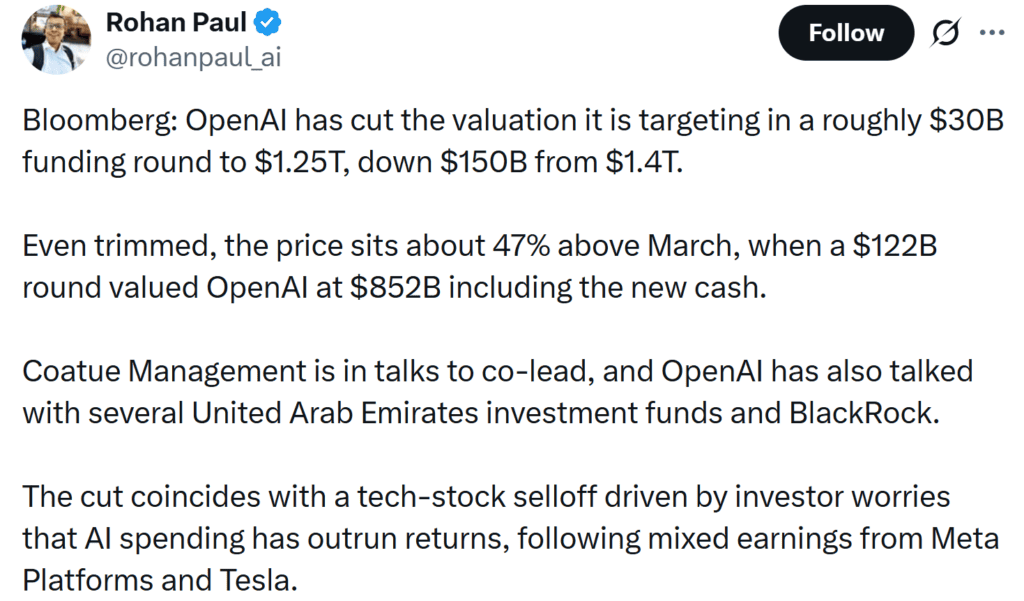
OpenAI lowered its valuation target by $150 billion to $1.25 trillion for a proposed $30 billion funding round, with negotiations ongoing. Source: Rohan Paul via X
The revised figure remains well above OpenAI’s March 2026 post-money valuation of $852 billion, established after a reported $122 billion funding round. The new target is approximately 47% higher, indicating that the company’s fundraising ambitions remain substantial despite the adjustment.
The revision does not mean OpenAI has lost $150 billion in realized market value. It reflects a change in the valuation proposed during private fundraising negotiations, which remain ongoing.
The timing is significant. Technology stocks have faced selling pressure following mixed earnings from companies including Meta Platforms and Tesla, intensifying investor concerns that AI infrastructure spending could be growing faster than the returns it generates.
Developing advanced AI systems requires substantial investment in specialized chips, data centers, electricity, and computing capacity. Investors are increasingly assessing whether commercial revenue can grow quickly enough to cover these expenses and support the valuations attached to AI developers.
Why Is OpenAI’s Valuation Falling?
OpenAI’s revised target follows reported investor resistance to its earlier $1.4 trillion valuation, according to the Financial Times. The adjustment may help narrow the gap between the company’s fundraising expectations and investors’ willingness to commit additional capital.
The broader technology selloff has added pressure, as investors reassess the financial returns expected from AI-related investments. However, the available information does not establish that infrastructure spending concerns alone caused OpenAI’s valuation adjustment.
The distinction between a proposed valuation and a completed funding valuation is important. Private-company valuations depend on negotiated financing terms and expectations about future growth, rather than daily market prices. Until the round closes, OpenAI’s $1.25 trillion target remains subject to change.
OpenAI Seeks $30 Billion Ahead of Potential IPO
OpenAI continues to pursue approximately $30 billion in new funding to finance its expansion. Bloomberg reported that Coatue Management was discussing a role as a co-lead investor, while BlackRock and investment funds from the United Arab Emirates were also involved in fundraising discussions.
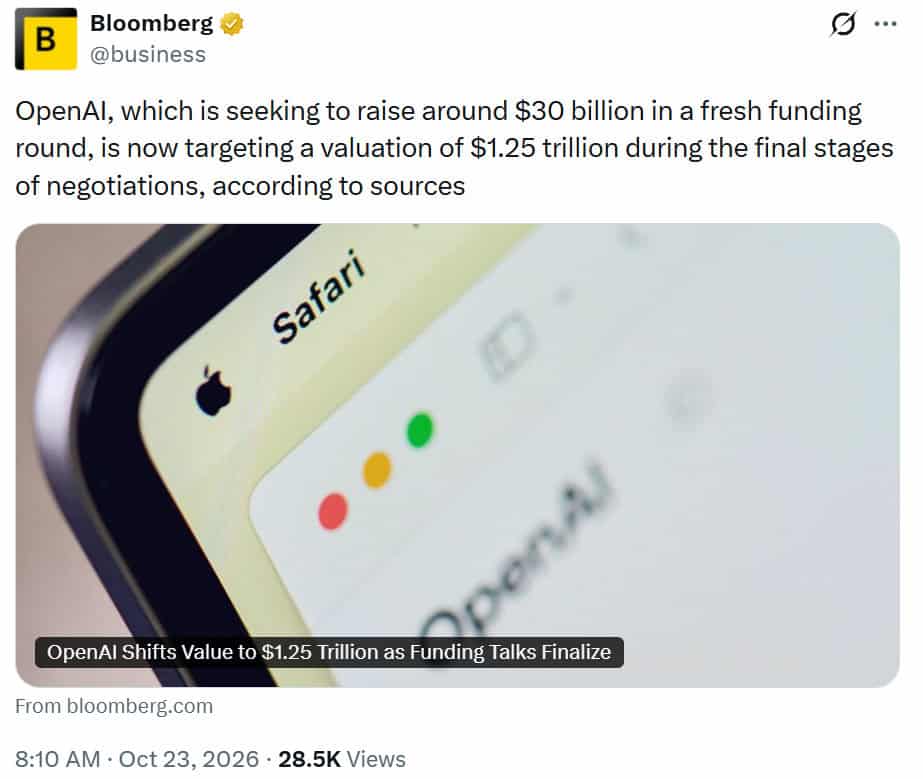
Bloomberg reports OpenAI has lowered its target valuation to $1.25 trillion for a $30 billion funding round amid investor pushback, down from an initial $1.4 trillion. Source: @business via X
Investor commitments could be finalized by the end of the following week, although the final funding amount and valuation remained uncertain.
The negotiations come as OpenAI prepares for a potential initial public offering in 2027. A public listing would bring greater scrutiny of its financial performance, capital requirements, and progress toward sustainable profitability.
The company faces a balancing act: continuing to invest in model development and computing capacity while demonstrating that its products can generate enough recurring revenue to support those costs. Its reported spending projections of approximately $278 billion in cash through 2030 illustrate the scale of that challenge.
OpenAI’s fundraising outcome could also influence investor expectations for Anthropic, which is preparing for its own potential IPO. Both companies must convince prospective investors that rapid growth can eventually translate into sustainable financial returns.
Anthropic S-1 Shows Red-Hot Growth, Risks, and Massive Computing Costs
Anthropic’s draft IPO prospectus offers another perspective on the financial pressures facing AI developers. According to The Wall Street Journal’s review of the document, the company generated $16.3 billion in revenue during the first half of 2026, up from $1.1 billion in the same period a year earlier.

Anthropic’s draft IPO filing reports $16.3 billion in H1 2026 revenue and an $80.7 billion net loss, largely driven by $72 billion in non-cash valuation charges on convertible instruments. Source: @WSJ via X
Despite that expansion, Anthropic recorded an $80.7 billion net loss, compared with $13 billion a year earlier. Approximately $72 billion of the latest loss came from non-cash accounting charges associated with changes in the estimated value of convertible financial instruments that could become company shares.
Those adjustments do not represent equivalent cash outflows from daily operations. Investors must therefore distinguish the reported net loss from operating expenses and cash-flow performance when assessing Anthropic’s financial health.
Infrastructure costs provide a clearer view of the resources required to operate its business. Anthropic spent nearly $9 billion on computing and infrastructure in the first half of 2026, compared with $2.3 billion a year earlier. The six-month total also exceeded its reported infrastructure spending for all of 2025.
Long-term commitments create additional financial exposure. Reports based on the draft prospectus place Anthropic’s cloud, computing, and infrastructure obligations above $600 billion, with some estimates reaching $750 billion when prospective agreements are included. Much of the spending is tied to contracts that cannot easily be cancelled.
These commitments help secure the capacity needed to meet demand, but they also reduce flexibility if revenue growth slows or computing requirements change.
Growth That Most Companies Never See
Anthropic’s revenue expansion remains substantial. First-half revenue rose from $1.1 billion in 2025 to $16.3 billion in 2026, reflecting growing demand for its AI products and services.
Its Claude Code coding assistant has helped attract developers and enterprise customers seeking tools to support software development and automate technical tasks. This business-focused approach can generate recurring revenue when customers incorporate AI products into their regular workflows.
Anthropic’s third-quarter revenue reportedly increased 45% to $16.8 billion from $11.6 billion in the second quarter. Although the increase remains significant, the sequential growth rate was slower than the more-than-doubling reported between the first and second quarters.
That moderation matters because investors must assess whether revenue can continue expanding fast enough to support rising infrastructure costs. Even a rapidly growing business can face financial pressure if expenses increase at a comparable or faster rate.
Investors have reportedly discussed an Anthropic valuation near $1.5 trillion, below earlier expectations of approximately $2 trillion. The proposed figure would still represent a substantial valuation, placing considerable weight on the company’s ability to maintain growth and improve margins.
The Bill for Being Compute-Starved
Access to computing capacity is a central constraint for advanced AI developers. Training models and operating them at scale require specialized chips, data centers, electricity, and cloud services. Securing sufficient capacity is essential, but competition for those resources can make expansion expensive.
Anthropic’s reported infrastructure commitments reflect the challenge. While estimates of its total obligations vary, the draft prospectus and related reporting point to hundreds of billions of dollars in potential spending over the coming years.
Non-cancellable agreements can provide greater certainty about access to computing resources, but they also create fixed obligations. If demand weakens, Anthropic may be unable to reduce those costs quickly enough to protect its margins.
Its relationships with infrastructure providers add another complication. Amazon, Google, and Microsoft supply cloud services while also developing their own AI products. This overlap creates competing commercial interests and may affect the availability, pricing, and terms of computing agreements.
Anthropic must therefore secure the resources required to serve customers without allowing infrastructure costs to outpace the revenue those resources generate.
Why the Whole Sector Is Watching
Anthropic’s potential IPO could test investor appetite for AI companies that combine rapid revenue growth with significant infrastructure commitments. Its financial disclosures give prospective investors a clearer view of both the commercial opportunity and the costs associated with competing in the sector.
The reception could influence expectations for OpenAI and other AI developers considering public listings. Investors will be watching whether strong revenue growth can support the valuations companies seek, particularly as infrastructure spending absorbs increasing amounts of capital.
OpenAI’s projected cash spending of approximately $278 billion through 2030 underscores the investment required to develop and operate advanced AI systems. The figure also highlights why investors are paying closer attention to capital allocation and the timing of future returns.
Broader technology-market volatility adds uncertainty. If investors become less willing to fund expensive expansion plans, AI companies could face pressure to lower their valuation expectations, reduce spending, or demonstrate a clearer path to profitability.
Is the AI Boom Cracking?
OpenAI’s valuation adjustment and Anthropic’s reported $80.7 billion first-half loss do not establish that the AI boom is ending. OpenAI’s proposed valuation remains above its previous funding benchmark, while Anthropic’s revenue growth demonstrates substantial commercial demand for AI products.
The developments instead highlight a shift in investor priorities. Alongside growth and technical progress, investors increasingly want evidence that AI revenue can cover computing expenses, long-term infrastructure obligations, and the continuing cost of developing advanced models.
OpenAI must secure funding on terms that support its expansion, while Anthropic faces scrutiny of its operating economics and infrastructure commitments ahead of a potential IPO. Both companies will need to show that their business models can support their substantial capital requirements.
The next phase of the AI market may depend less on the amount of capital companies attract and more on how effectively they convert that investment into sustainable earnings and cash flow. The latest disclosures point to greater financial scrutiny, but whether that develops into a broader market correction will depend on actual performance, investor demand, and the industry’s ability to deliver lasting returns.
 Brave New Coin reaches 1M+ engaged crypto enthusiasts a month through our website, podcast, newsletters, and YouTube. Get your brand in front of key decision-makers and early adopters in 2026. Limited slots remaining! Find out more today!