Russia Opens a Regulated Bitcoin Door on November 17—With a ₽300,000 Limit

Russia’s approved crypto list takes effect on November 17, bringing Bitcoin, Ether and USDT into a regulated retail framework. The opening comes with tests, purchase limits and a crucial distinction between legal approval and actual trading.
Russia crypto rules taking effect on November 17 put Bitcoin, Ether and USDT on the approved list for non-qualified investors, marking a concrete step towards regulated retail access in one of cryptocurrency’s most politically complicated markets.
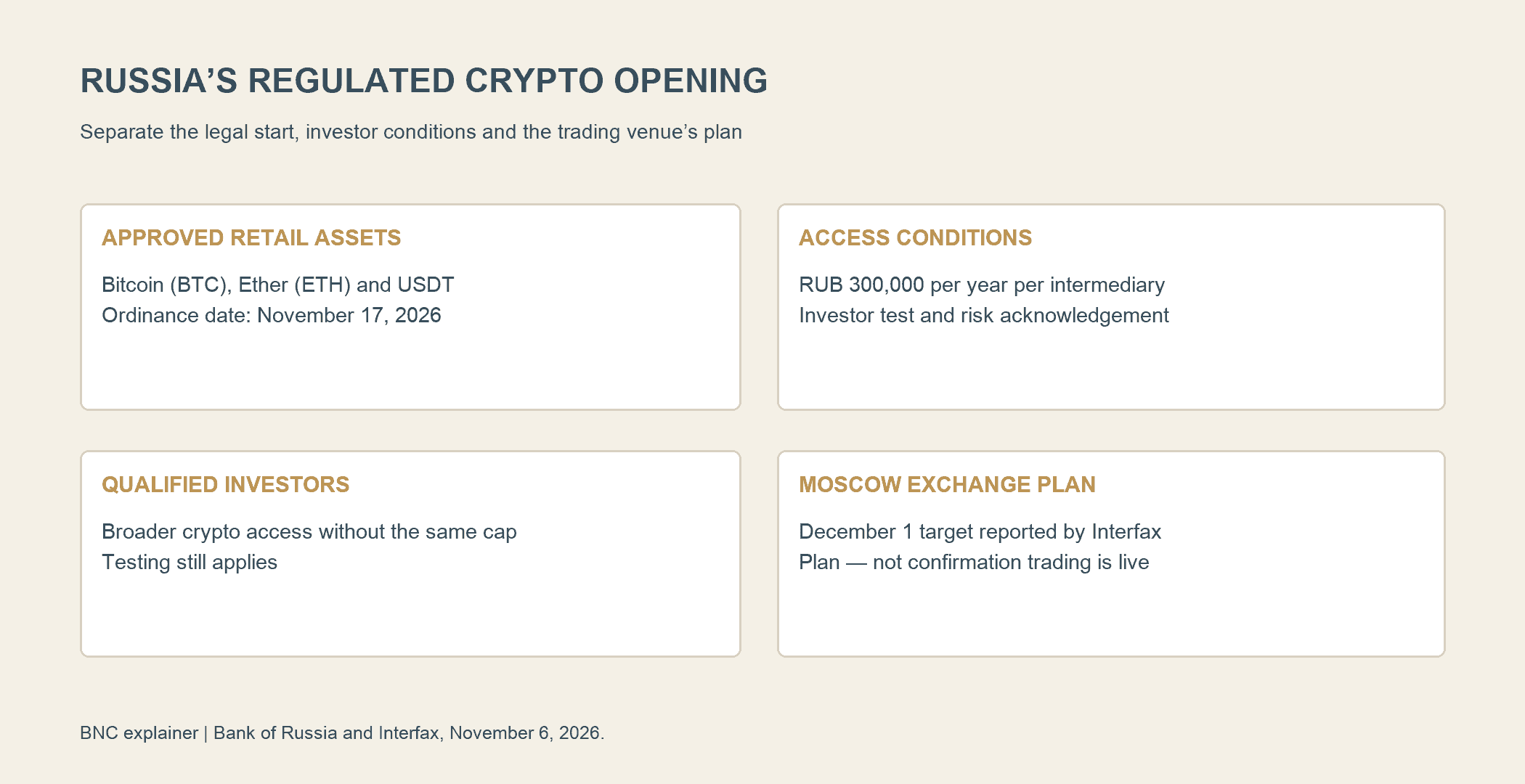
The Bank of Russia’s November 6 announcement allows purchases through intermediaries, subject to a ₽300,000 annual limit through each intermediary and an investor test. The date is a regulatory milestone, rather than proof that every broker or exchange has already opened its doors.
For the global market, the immediate question is how much usable access follows. A country approving crypto assets creates potential demand. It does not establish that the full permitted amount will be invested, or that Bitcoin’s price will respond.
What changes under the Russia crypto rules?
The central bank says the ordinance takes effect on November 17. Its notice states: “From that date, these assets may be publicly traded on exchanges.” The assets named are Bitcoin, Ether and USDT.
Non-qualified investors may use brokers, trust managers or crypto exchange offices in exchange and over-the-counter markets. The limit applies through a single intermediary, an important qualification when interpreting the cap.
Qualified investors have broader access without the same purchase restriction, but the notice says testing and acknowledgement of investment risks apply regardless of investor status. Permission therefore comes with an access process, rather than simply adding a buy button.
The regulator says selection considered liquidity, market capitalisation and at least five years of foreign-exchange pricing history. Inclusion is an eligibility decision; it is not a guarantee against losses.
Approval and a market launch are different dates
Interfax reported on November 6 that Moscow Exchange was targeting December 1 for cryptocurrency transactions and testing operations with professional participants. The report attributed the plan to senior managing director Boris Blokhin’s earlier comments.
That is a planned commercial launch, separate from the ordinance’s legal start. Readers should distinguish an asset being eligible for admission from a venue actually offering a functioning market to a particular customer.
The difference has practical consequences. A broker needs an available service, account arrangements and a way to settle transactions. A legal date does not demonstrate that all those steps have been completed for every participant.
Nor should a stated launch target be treated as a confirmed opening-day volume. The more informative evidence will be operating notices from venues, actual customer access and recorded trading after services begin.
The infrastructure has been taking shape
In an October 6 announcement, the Bank of Russia said it had admitted the first five digital depositories and four cryptocurrency exchange organisations under transitional provisions of the new framework.
The regulator described digital depositories as recording and transferring digital currencies and rights, while exchange organisations could buy and sell digital currencies on their own account outside organised trading.
Those functions help explain why this is more than an approved-coin list. A regulated market needs arrangements for holding, recording and moving investors’ rights as well as somewhere to agree a price.
For customers, the questions become familiar financial-service questions: who records the holding, how withdrawals work and what recourse exists if an intermediary fails. Regulatory recognition makes those questions more visible; it does not remove them.
Buying Bitcoin does not make it domestic payment money
The central bank’s July explanation of the broader law said the framework would take effect on September 1. It retained the prohibition on using cryptocurrency for payments inside Russia, while providing separately for exporters and importers to use it in cross-border transactions.
The distinction is central to the policy. An asset can be permitted for investment without becoming an accepted means of paying a domestic shop. Retail trading access and international commercial settlement belong to different parts of the framework.
It also prevents an investment announcement from being mistaken for an official endorsement of Bitcoin as a replacement for national money. The permissions concern specified activities, participants and channels.
For overseas observers, domestic permission is also only one part of the picture. A Russian rule cannot by itself determine a foreign provider’s eligibility requirements or willingness to serve a customer. The route available on paper and the route available in practice may differ.
How much new Bitcoin demand could follow?
The annual cap places a ceiling on an individual channel, but does not measure aggregate purchases. Estimating demand would require the number of eligible customers, their take-up rate and how much they actually allocate.
Some activity could also move from existing trading routes into the regulated system. In that scenario, higher reported domestic volume would not necessarily represent an equal amount of brand-new cryptocurrency demand worldwide.
BNC’s coverage of Bitcoin ETF flows illustrates why access and money flows need separate measurements. A market can have established investment products while investors are withdrawing capital.
The strongest follow-up indicators will be live market access, net purchases and reliable custody arrangements. November 17 supplies a clear legal milestone. What investors do with the new route will determine its market significance.
 Brave New Coin reaches 1M+ engaged crypto enthusiasts a month through our website, podcast, newsletters, and YouTube. Get your brand in front of key decision-makers and early adopters in 2026. Limited slots remaining! Find out more today!