

Crypto Market Forecast: Week of February 27th 2023

A curated weekly summary of forward-focused crypto news that matters. This week, crypto pulls back in the face of multi-frontal regulatory attacks and hot economic data, Iraq opts to offer import settlement flexibility outside of US dollars, and economic data emerging from the USA is mixed.
The price of Bitcoin (BTC) fell by ~6.8% this week and currently sits at ~US$23.2K. Ether (ETH) dropped by 6.3%, and currently trades for ~US$1.6K. Binance-coin (BNB) fell by 3.9%, presently it sits at ~US$305.
After a recent series of seemingly coordinated regulatory crackdowns on players within the industry over the past few weeks, US SEC commissioner Hester Peirce spoke out, calling her own agency “paternalistic and lazy” and “hostile to crypto”. Peirce first published her dissent of the agency’s shut down of Kraken’s staking-as-a-service on the SEC’s own website and followed up with additional reasons in an interview with Reason.tv.
In the same interview, Nic Carter appeared, referring to recent regulatory crackdown as “a multi-front attack”, “happening on a coordinated basis [with guidance coming] from multiple agencies and organs of government within the same day, within hours”. Some of the more notable events from the past month include:
- Beyond shutting down the staking service, Kraken was also made to pay a $30M fine.
- On January 27th, the Fed announced that it had denied Wyoming-based Custodia Bank membership with the Federal Reserve System, stating that the bank “presented significant safety and soundness risks”.
- The SEC also ordered Paxos to stop its trading in Binance’s USD stablecoin BUSD – and allegedly plans to sue for not registering the asset as a security. Paxos then announced in a press release that it would “end its relationship with Binance for the branded stablecoin BUSD”. Binance is now looking to de-risk, severing ties with the US.
Glassnode analysis shows that Binance’s BUSD stablecoin had over a 12% supply dominance in the stablecoin market on February 13th. By February 25th, it had fallen to 8.6% – with USDT, USDC and DAI all picking up a distributed share of the difference.
Adding yet another datapoint to the rising trend towards de-dollarization, the Iraqi central bank announced that it will permit settlement of payment for Chinese imports in yuan (CNY). Reuters reported on Wednesday that the move was to compensate for a local shortage of US dollars.
Iraqi government economic adviser Mudhir Salih told Reuters that “It is the first time imports would be financed from China in yuan, as Iraqi imports from China have been financed in (U.S.) dollars only”.
Wyoming House of Representatives have passed Bill HB0086, which prohibits the compelled disclosure of private cryptographic keys except in certain cases in which (1) the public key is “unavailable or unable to disclose the requisite information with respect to the digital asset, digital identity or other interest or right” or (2) part of a lawful proceeding.
The act becomes effective beginning July 1st, 2023.
Crypto news for the weeks ahead
28 February
Sepolia Testnet, Ethereum’s next big test before the March ‘Shanghai’ hard fork, will take place on 28 February.
March 14th
The Consumer Price Index data for February 2023 will be released – one of the indicators the Federal Open Market Committee (FOMC) watches when considering interest rate hikes.
21-22 March
The FOMC will be meeting. Possible further additional interest rate hikes will be announced. Markets are presently leaning towards yet another interest rate hike, currently expected at 25 bps.
March 2023
Ethereum’s next major upgrade since the Merge, the ‘Shanghai’ hard fork, will allow stakers to withdraw staked ETH, which presently remains locked.
Top 10 Crypto Summary
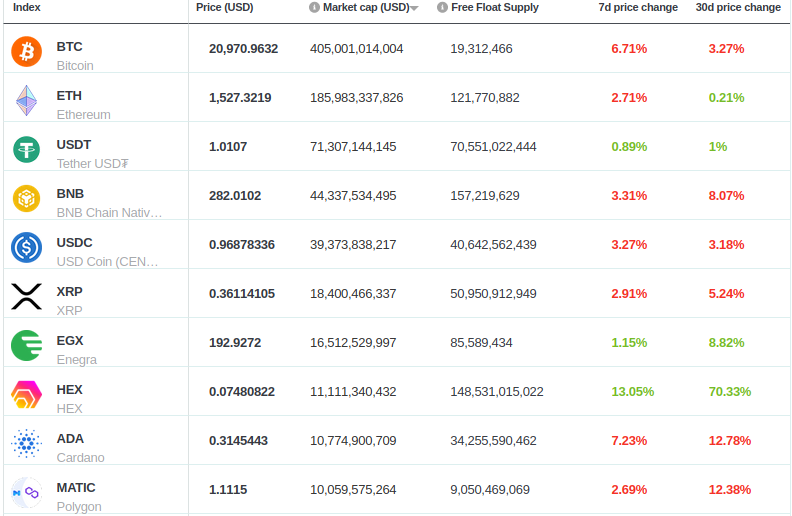
There was a movement downward this week for Brave New Coin’s top 10 digital assets by market cap – stablecoins aside, of course. The drop follows both recent regulatory crackdowns in the USA as well as the US Bureau of Economic Analysis’ (BEA’s) release of January’s Personal Consumption Expenditures (PCE) numbers. The indicator has shown a steady trend downward in recent months (supporting the Fed’s “disinflation” narrative) as compared to the same months of the previous year, but a slight uptick for January (from December’s 5.3% change to January’s 5.4%) seems to have played at least some part in instigating a risk asset price drop.
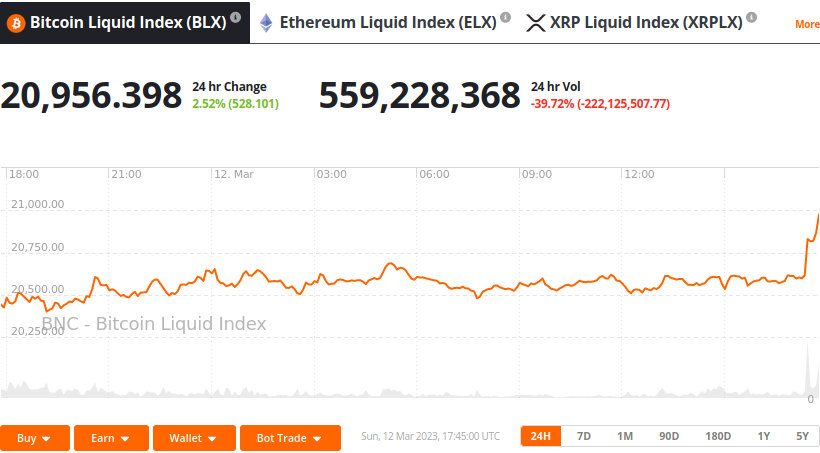
Bitcoin Price Chart
Perhaps one benefit of the recent launch of controversial ordinals and inscriptions on the Bitcoin blockchain is the spike in adoption for Taproot. They are controversial primarily because they occupy scarce block space. Taproot offers increased functionality for smart contracts and the Lightning Network – including better privacy. Glassnode uses two indicators to measure Taproot’s adoption: one they call ‘utilization’ and the other, just ‘adoption’. Both measures have spiked since the first part of February. The ‘adoption’ measure would be what we typically call a massive “hockey stick spike”. So while there is an upward push on transaction fees, there is also a push towards familiarization of Taproot and its added benefits – even beyond ordinals and inscriptions.
 Brave New Coin reaches 1M+ engaged crypto enthusiasts a month through our website, podcast, newsletters, and YouTube. Get your brand in front of key decision-makers and early adopters in 2026. Limited slots remaining! Find out more today!


