Nvidia Shares Slide as Jensen Huang Probe Puts the AI Trade on Edge

Nvidia shares fell as the Jensen Huang investigation raised governance questions. What the board has said, what remains unproven and what comes next.
Nvidia shares fell more than 4% on Monday as the Jensen Huang investigation gave investors a company-specific problem during a wider rebound in AI stocks. The question is no longer simply what happened in the chief executive’s private life. It is whether Nvidia can demonstrate that its security controls worked when its most influential executive allegedly became a foreign intelligence target.
The contrast was striking: other AI-related shares, including AMD and CoreWeave, rose, according to the Associated Press. That divergence does not prove investors have reached a verdict on the allegations. It shows how uncertainty about leadership and governance can interrupt even a powerful sector rally.
The admission and the allegation are different
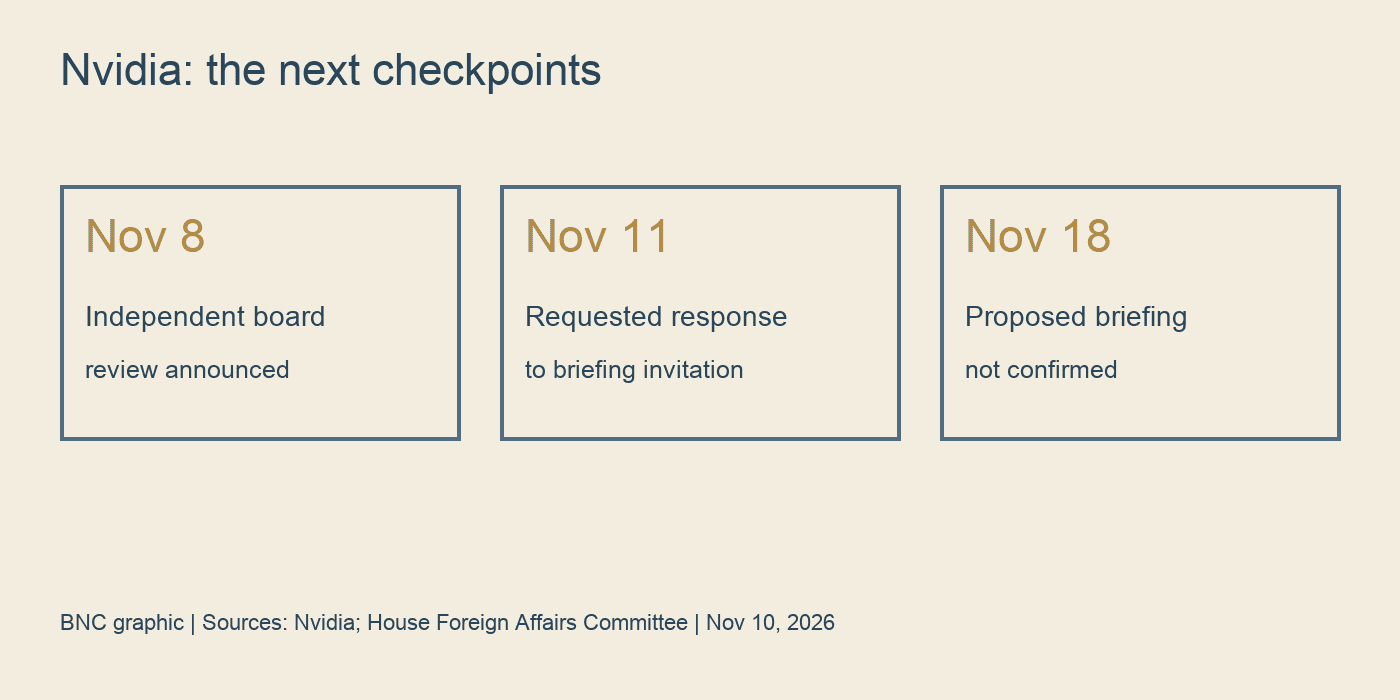
Huang has acknowledged infidelity. In his November 8 message to employees, he wrote: “I was unfaithful to my wife.” He apologised to his family and employees and promised to cooperate with the independent investigation.
Those admissions establish a personal betrayal. They do not establish that he knowingly helped a foreign intelligence service or disclosed confidential information. Reporting about an alleged Chinese intelligence operation remains the subject of an inquiry, and China has denied the spying allegations.
BNC’s earlier account of the Huang affair and Nvidia’s initial response explains how the relationship became a corporate security issue. The next phase concerns evidence, oversight and the credibility of the company’s response.
What Nvidia’s board has actually said
The Nvidia board’s statement says independent directors, supported by outside independent lawyers, will oversee the investigation. Huang supports the review, and the board has expressed confidence in him and his leadership team.
Crucially, the directors said they have “no reason to believe that either national security or NVIDIA secrets were compromised.” That is the board’s current assessment, rather than a completed investigative finding. Its statement also commits the inquiry to examining all available information.
For shareholders, the distinction matters. A board can reasonably retain confidence in a founder while testing whether safeguards around that founder were adequate. The quality of the investigation will depend on what it examines and how clearly the directors communicate its conclusions, not simply on the strength of their initial endorsement.
Why this reaches beyond one executive
Nvidia’s commercial power rests partly on customers trusting it with infrastructure at the centre of their AI strategies. A security investigation involving the chief executive therefore raises questions that extend beyond a personnel decision: who had access, what information could be shared, and whether normal controls applied consistently at the top.
These are questions for the review, not established failures. There is currently no public basis in the board’s statement for claiming that a product roadmap, customer record or trade secret was leaked. Treating every imaginable exposure as an actual breach would turn uncertainty into misinformation.
Nevertheless, uncertainty has a cost. Investors must assess an earnings business while also weighing outcomes that financial guidance cannot settle. Even strong chip demand would not, by itself, answer questions about executive access or corporate oversight.
Congress adds a deadline
Three Republican committee chairs have requested a joint briefing. Brian Mast, John Moolenaar and Rick Crawford asked Huang to accept a proposed November 18 closed-door briefing or offer another congressional session date by November 11.
The request focuses on his interactions with Megaspeed executive Alice Huang and Nvidia’s safeguards against foreign espionage. It is a request for information, not a congressional determination of guilt, and the proposed briefing should not be described as a confirmed appearance.
The political stakes are considerable because advanced AI chips already sit inside a difficult debate over commerce and national security. A company’s internal review and lawmakers’ oversight can proceed on different schedules, with different standards for what they disclose publicly.
That creates a difficult communications problem. Investors want clarity quickly; investigators need a defensible factual record. Closed-door testimony may answer lawmakers’ questions without immediately satisfying shareholders or the public.
The next test is evidence, then earnings
Nvidia has separately announced its next quarterly earnings call. That creates two tracks for investors to follow: the operating performance of the chip business and the unresolved governance questions surrounding its leader.
Neither track cancels the other. Strong results could support the commercial investment case while leaving security questions open. Equally, an investigation is not evidence that demand for Nvidia’s products has suddenly disappeared. The useful task is to identify which new disclosures affect revenue, which affect oversight, and which merely repeat existing allegations.
For now, the most meaningful developments would be a substantive board update, clarity about the requested congressional briefing, and evidence supporting or ruling out a compromise. Another round of speculation about private motives would add little.
Huang’s personal apology is already public. What the market still lacks is a completed account of the alleged intelligence effort and whether Nvidia’s protections held. Until that arrives, confidence in the founder and confidence in the controls will remain connected, but separate, investment questions.
 Brave New Coin reaches 1M+ engaged crypto enthusiasts a month through our website, podcast, newsletters, and YouTube. Get your brand in front of key decision-makers and early adopters in 2026. Limited slots remaining! Find out more today!