Nvidia Loses $225B in Market Value as Jensen Huang Faces Board Probe Over China Spy Allegations
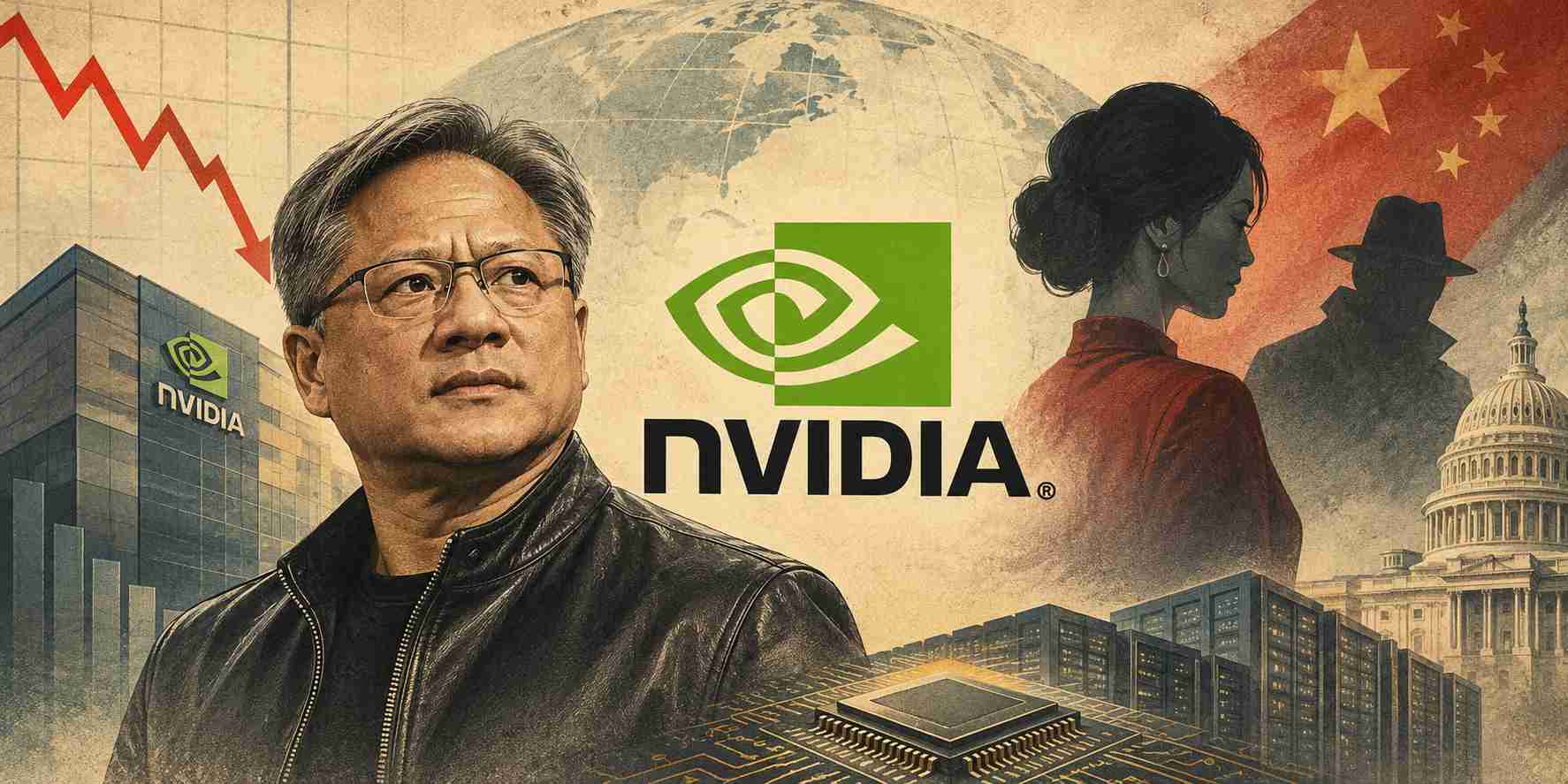
Nvidia shares fell more than 5% in premarket trading on November 9, wiping approximately $225 billion from the company’s market value after its board announced an independent investigation into reports that CEO Jensen Huang was targeted by a foreign intelligence operation.
The investigation follows reports linking Huang to Alice Huang, a former executive at Singapore-based data center company Megaspeed, who US intelligence officials reportedly suspected of working for China’s Ministry of State Security. The controversy has raised questions about Nvidia’s corporate security, AI chip exports, and the potential national security implications of its international business relationships.
Nvidia Board Launches Independent Investigation Into Jensen Huang
Nvidia’s board announced the investigation on November 8 following reports that Huang may have been targeted by a foreign intelligence effort. A committee of independent directors, working with external legal counsel, will oversee the review.
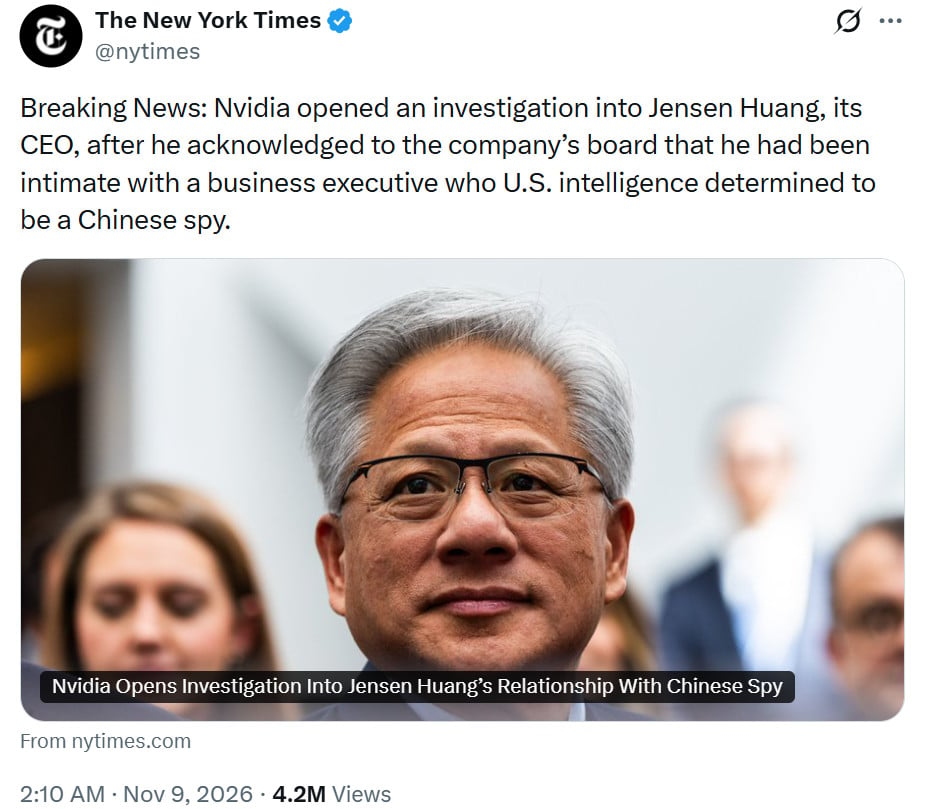
Nvidia launched an investigation into CEO Jensen Huang after he disclosed an intimate relationship with a business executive later identified by U.S. intelligence as a Chinese spy. Source: The New York Times via X
In its official statement, the board said it had “no reason to believe that either national security or NVIDIA secrets were compromised.” However, it said the investigation would examine all available information and assess the circumstances surrounding the reported intelligence operation.
Huang has agreed to cooperate fully with the investigation. The board also expressed confidence in his leadership and indicated that further updates would be provided when appropriate.
The announcement followed reports that US authorities had examined Alice Huang’s connections to Nvidia and her relationship with its chief executive. The allegations have attracted attention because of Megaspeed’s role in purchasing advanced Nvidia processors amid Washington’s restrictions on semiconductor exports to China.
$4.8 Billion Nvidia Chip Purchases Raise Export Control Concerns
The investigation also places Megaspeed’s semiconductor purchases under greater scrutiny. According to reporting by The New York Times, the company’s Malaysian affiliate purchased at least $4.8 billion worth of advanced AI equipment containing Nvidia technology between June 2024 and February 2026, based on trade records obtained from ImportGenius.
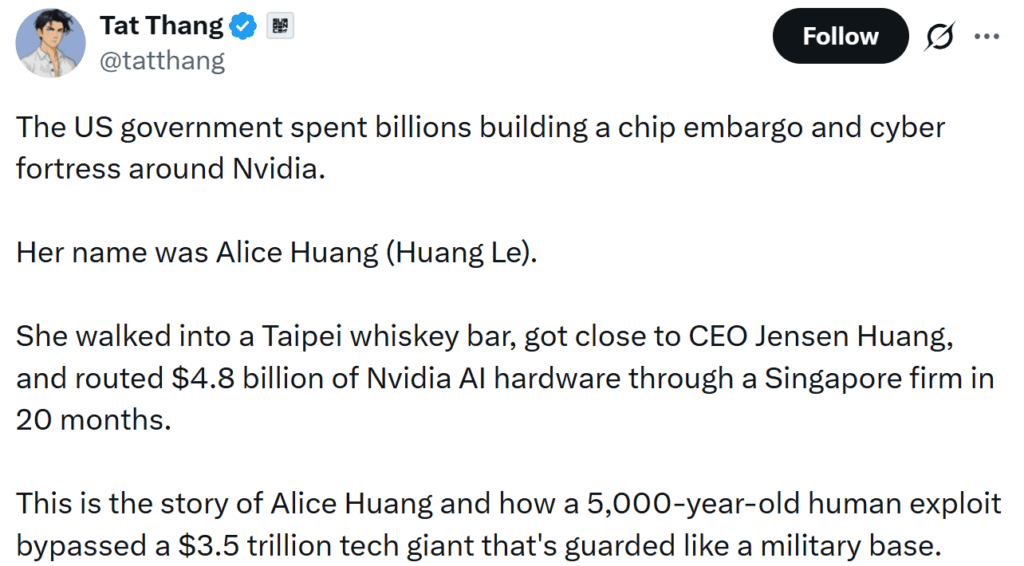
Nvidia’s Jensen Huang allegedly facilitated $4.8 billion in AI chip shipments to Chinese clients through Southeast Asia, bypassing U.S. export restrictions. Source: @tatthang via X
US authorities have examined whether Megaspeed helped Chinese companies obtain access to advanced AI processors restricted under American export controls. The company operates as a data center intermediary, purchasing computing equipment and renting processing capacity to customers, including Chinese technology group Alibaba.
The reported transactions have attracted attention because Washington has imposed restrictions on advanced semiconductor exports to limit China’s access to computing resources used in artificial intelligence development. Investigators reportedly suspect that some processors acquired through the Southeast Asian business network may have reached China in violation of those restrictions. However, the available reporting does not establish that every purchase or shipment breached US export rules.
The allegations have also prompted separate scrutiny of Megaspeed’s operations. Singapore’s Ministry of Home Affairs clarified on October 31 that its government had not investigated Alice Huang or expressed concerns about her alleged intelligence connections. However, Singapore’s police confirmed that investigations into Megaspeed were ongoing and declined to provide further details.
Jensen Huang Admits Infidelity as China Spy Allegations Intensify
The controversy intensified after Huang sent an apology to Nvidia employees on November 8, acknowledging that he had been unfaithful to his wife. Although he did not identify the woman involved, reports linked the relationship to Alice Huang, who is not related to the Nvidia CEO.
In his message, Huang accepted responsibility for the personal and professional consequences of his actions. He apologized to his family, employees, board members, business partners, and shareholders, acknowledging that he had fallen short of the responsibility associated with leading the company.
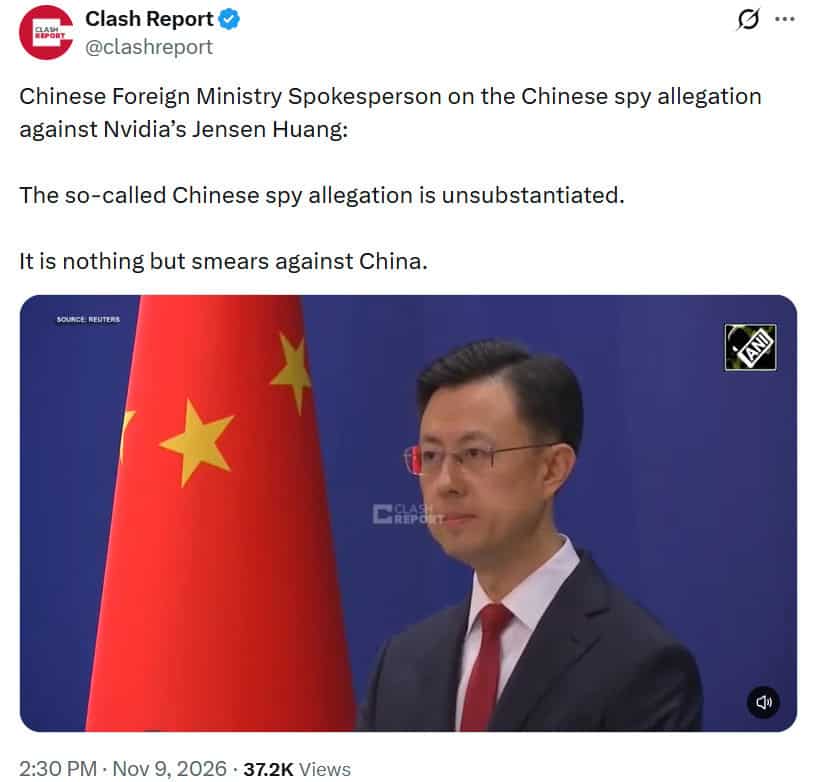
China’s Foreign Ministry dismissed the allegations against Nvidia CEO Jensen Huang as unsubstantiated, calling them smears against China. Source: @clashreport via X
Huang also addressed the national security concerns directly, confirming his support for the board’s independent investigation and pledging full cooperation. He reaffirmed his commitment to Nvidia and said he would continue working to protect the company and support US national security.
The allegations against Alice Huang remain a central part of the investigation. Reporting by The New York Times cited people briefed on classified intelligence who said US officials had concluded that she was gathering information for Beijing. The reporting also raised concerns about whether her access to Nvidia’s CEO could have exposed sensitive corporate or government-related information.
However, the intelligence allegations have not been established through a public investigation finding. China rejected the claims on November 9, with Foreign Ministry spokesperson Guo Jiakun describing them as unsubstantiated and an attempt to discredit Beijing.
Nvidia Stock Faces Pressure Over Leadership Uncertainty
The investigation has added another source of uncertainty for Nvidia investors, who were already assessing concerns about the sustainability of AI-related spending. Nvidia shares had come under pressure alongside other technology stocks following a broader market downturn.
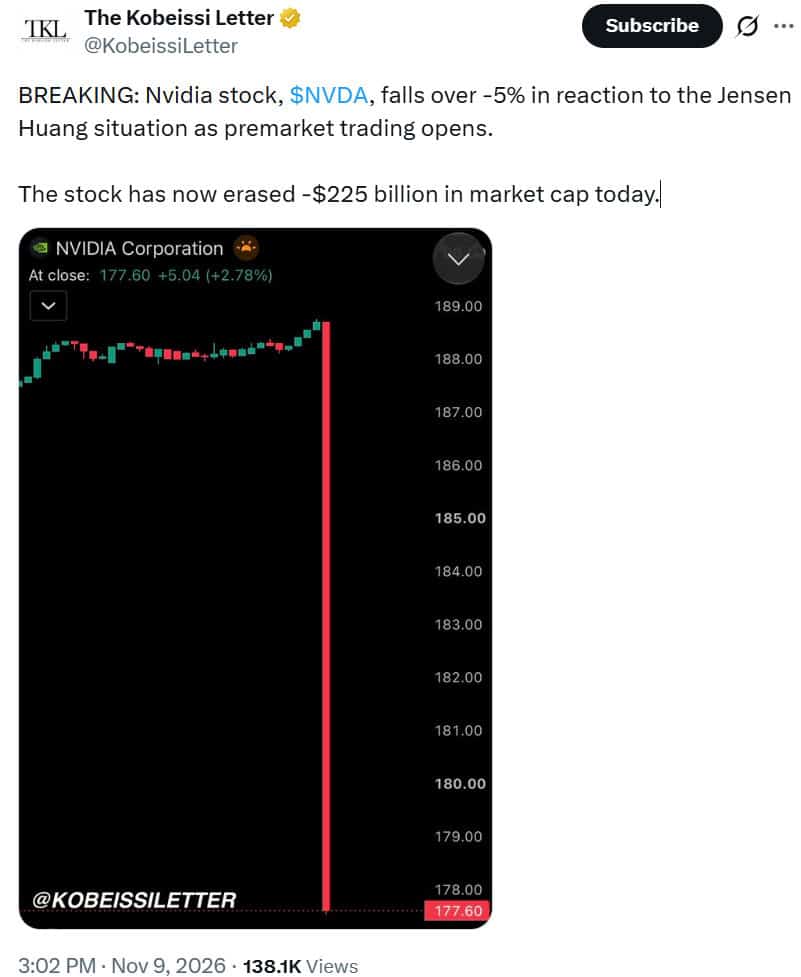
NVDA fell over 5% on November 9, wiping out approximately $225 billion in market value after news of a board investigation into CEO Jensen Huang. Source: @KobeissiLetter via X
Early trading data on November 9 showed NVDA falling approximately 4.5% to 5% before the US market opened. Its market capitalization was estimated at around $4.51 trillion, representing an implied decline of roughly $225 billion from its previous valuation. The early movement highlighted how quickly concerns surrounding the company’s leadership can affect investor sentiment.
The potential leadership implications are particularly relevant because Huang has led Nvidia for more than three decades and played a central role in its transformation into a dominant supplier of AI processors. His influence extends beyond product development, with the company’s global strategy and relationships across the technology industry closely associated with his leadership.
Dan Ives, an analyst at Yorkville Ives & Co., warned that the investigation could create additional pressure on the stock. He said there was a risk Huang could be removed depending on the board’s findings, adding that the uncertainty would weigh on Nvidia because of the CEO’s importance to its global strategy.
However, Nvidia has indicated that Huang intends to remain in his position while the review proceeds. A company spokesperson said he was committed to continuing as CEO without interruption. The board has also expressed confidence in his leadership team, although its investigation leaves questions about the potential consequences of the reported intelligence operation.
The controversy also comes at a sensitive time for the semiconductor industry. US restrictions on advanced AI chip exports to China remain a significant factor in Nvidia’s international business strategy. Greater scrutiny of its customers, distribution partners, and export compliance procedures could add regulatory pressure to an already complex market.
For now, the board’s investigation has not established that Nvidia’s trade secrets or US national security information were compromised. Its findings, together with the company’s response to export-control concerns, will be important in determining whether the controversy creates lasting consequences for Nvidia’s leadership, investor confidence, and position in the global AI market.
 Brave New Coin reaches 1M+ engaged crypto enthusiasts a month through our website, podcast, newsletters, and YouTube. Get your brand in front of key decision-makers and early adopters in 2026. Limited slots remaining! Find out more today!