OpenAI CFO Defends AI Data Centers After Midterm Backlash, Promises No Higher Electricity Bills

OpenAI CFO Sarah Friar has defended the company’s data center expansion, pledging to protect local households from higher electricity bills as opposition to AI infrastructure grows across the United States.
Speaking to CNBC on November 6, Friar addressed concerns about electricity consumption, water use, and noise pollution following a wave of anti-data-center votes in the November 3 midterm elections. She said OpenAI would work with local utilities, invest in electricity infrastructure, and maintain closer relationships with communities hosting its facilities.
OpenAI Pledges to Protect Consumers From Higher Electricity Bills
During an interview with CNBC’s Sara Eisen on Squawk on the Street, Friar said OpenAI understood that local residents were concerned about the financial impact of expanding AI infrastructure. She stressed that the company would cover its energy costs rather than shift the financial burden onto households.
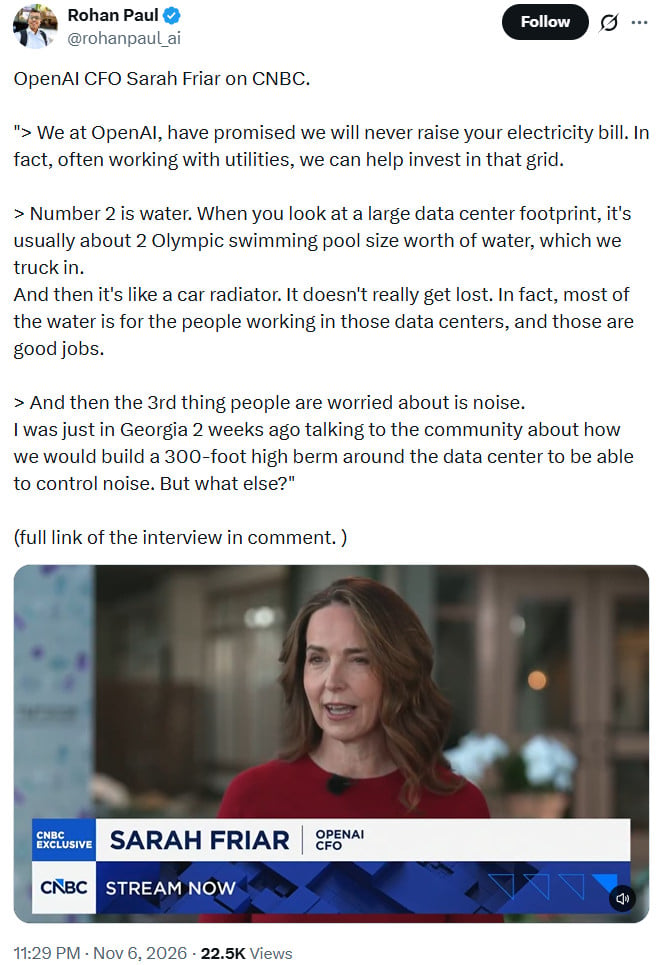
OpenAI CFO Sarah Friar said the company would protect consumers from higher electricity bills, invest in local power grids, and use recyclable water at its AI data centers. Source: Rohan Paul via X
“OpenAI, we have promised we will never raise your electricity bill,” Friar said, adding that the company could also work with utilities to invest in the electricity grid.
Her comments followed OpenAI’s November 5 announcement of a National Community Compact, which outlines commitments for future computing campuses that the company owns and operates. Under the framework, OpenAI will cover the full cost of electricity consumption and the infrastructure required to serve its facilities.
The company also pledged to provide financial assurances before substantial project spending begins. These guarantees are intended to protect other electricity customers if a planned data-center project is delayed, reduced in scope, or canceled after infrastructure investments have been made.
OpenAI’s electricity commitments also include plans to make its facilities more flexible during periods of high demand. The company’s Grid Protectors Program, introduced on November 2, outlines arrangements through which future computing campuses could reduce electricity consumption when local power systems face pressure.
One example involves OpenAI’s planned Effingham County campus in Georgia. Its agreement with Georgia Power allows the utility to reduce electricity delivered to the facility by as much as 1,000 megawatts during periods of high demand.
The arrangement is designed to help preserve electricity for households and businesses during periods of grid stress. However, its effectiveness will depend on the implementation of the agreement and the operational capabilities of the planned campus.
OpenAI Addresses Data Center Water Consumption and Noise
Electricity costs were not the only concern raised during the interview. Friar also discussed water consumption, another issue attracting attention as companies expand infrastructure to support artificial intelligence workloads.
She estimated that a large data center typically requires approximately two Olympic swimming pools’ worth of water, explaining that the company trucks the water to its facilities.
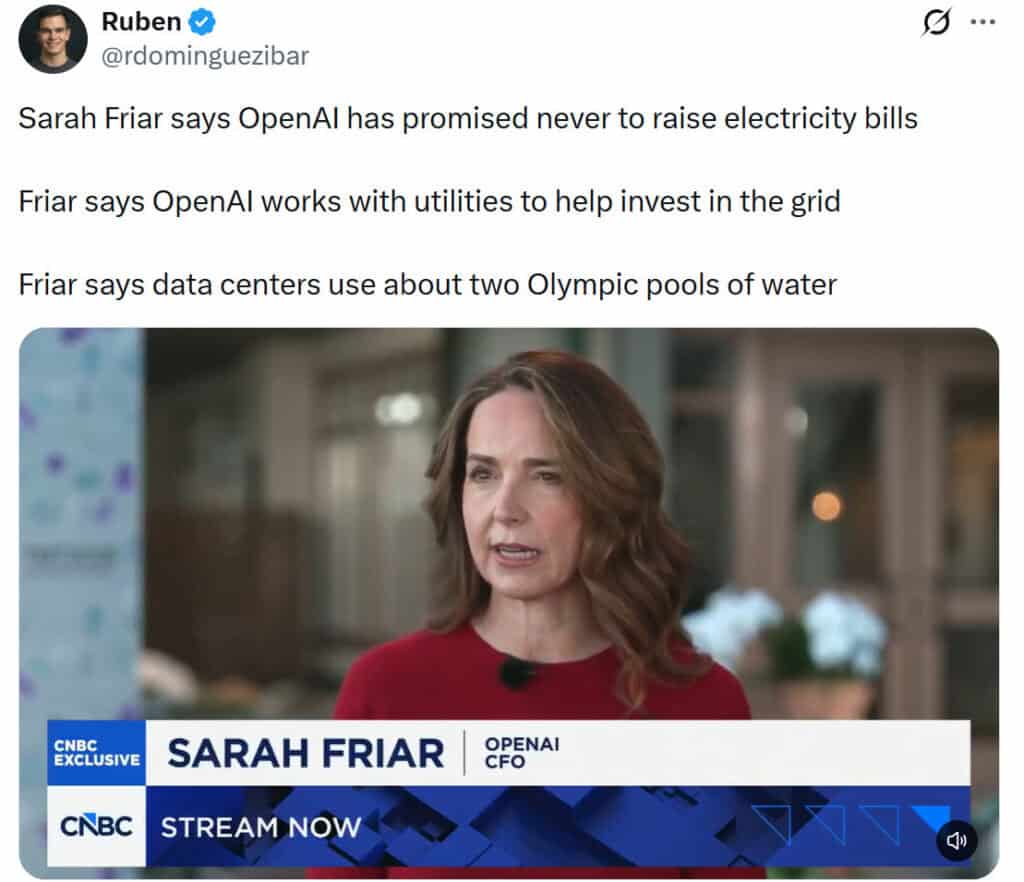
Sarah Friar said a typical data center uses around two Olympic pools of trucked-in water, which is recirculated, with most consumption attributed to employee needs rather than cooling. Source: @rdominguezibar via X
Comparing the system to a car radiator, Friar said the water does not simply disappear. She also claimed that most of the water associated with the facilities is used by employees working inside the data centers rather than by cooling operations.
OpenAI’s November 5 community framework provides further detail on its approach to water management. The company committed to developing a water plan for each campus, prioritizing closed-loop or low-water cooling systems, and publishing site-level electricity and water consumption figures.
These commitments are intended to give residents greater visibility into the environmental footprint of individual facilities. They also create a framework for comparing operational resource use across different locations.
Noise pollution is another issue OpenAI is attempting to address. Friar said she had recently visited Georgia to discuss plans for constructing a 300-foot-high berm around a data center to reduce noise reaching nearby communities.
The company’s broader policy also calls for publishing construction plans and commissioning independent noise studies before facilities begin operating, with annual reporting afterward. This would give residents more information about expected noise levels and the measures being taken to limit disruption.
Midterm Results Highlight Growing Opposition to AI Infrastructure
Friar’s comments came after voters across the United States backed restrictions on data center development during the November 3 midterm elections.
According to NBC News, voters favored limiting data-center development in 40 of the 41 local ballot measure contests held that day. The measures covered 10 states and addressed different aspects of development, including construction bans, temporary moratoriums, zoning restrictions, and additional community approval requirements.
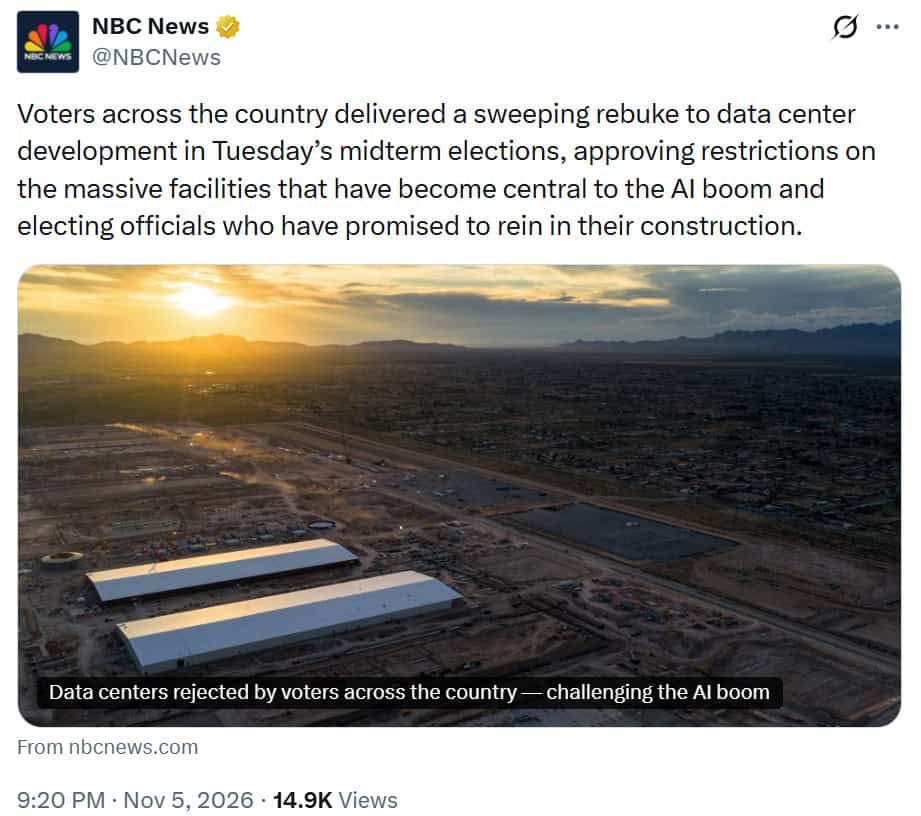
Voters approved restrictions on data centers in nearly all 41 local ballot measures nationwide during the 2026 midterms, signaling growing opposition to AI infrastructure expansion. Source: @NBCNews via X
Voters approved 27 measures that restricted development or expressed opposition to data centers. They also rejected 13 proposals that would have supported or facilitated new projects. Harwood, North Dakota, was the only exception, where voters rejected a proposed review requirement for certain developments, including data centers.
The results reflect growing concerns about the potential impact of large computing facilities on local electricity supplies, water resources, land use, and residential communities.
The political response has also increased pressure on technology companies to explain how their infrastructure projects will affect surrounding areas. OpenAI’s latest commitments arrive as residents and local officials seek greater control over development decisions and clearer protections against additional utility costs.
OpenAI Introduces Community Commitments as AI Expansion Continues
Alongside Friar’s CNBC interview, OpenAI has outlined a broader framework intended to improve transparency and accountability around its data center projects.
Under its National Community Compact, the company plans to establish a local agreement for every future campus it owns and operates. Residents will be engaged early enough to influence project plans, while each location will have a designated contact throughout the facility’s operating life.
OpenAI also committed to publishing annual updates covering its performance and community commitments. The framework includes local employment initiatives, partnerships with unions and workforce-training providers, and investments in community priorities.
In Effingham County, Georgia, residents helped shape a $4.8 million grant supporting free school meals for students. In Pike County, Ohio, OpenAI and SB Energy announced a joint $6 million commitment focused on childcare.
The company has also published a policy blueprint urging federal, state, and local policymakers to establish industry-wide requirements for data-center development. Its proposals include requiring large electricity consumers to cover the additional grid costs they create, protecting existing ratepayers if projects are abandoned, and improving transparency around energy, water, and noise.
However, the National Community Compact specifically covers future computing campuses that OpenAI owns and operates. Its commitments should not be interpreted as automatically applying to every third-party facility involved in the company’s broader computing network.
For OpenAI, the challenge is now to translate its public commitments into measurable results as demand for AI computing capacity continues to grow. Friar made clear that election outcomes would not end the company’s infrastructure investment plans, but maintaining community support will remain an important part of its expansion strategy.
 Brave New Coin reaches 1M+ engaged crypto enthusiasts a month through our website, podcast, newsletters, and YouTube. Get your brand in front of key decision-makers and early adopters in 2026. Limited slots remaining! Find out more today!