OpenAI Countersues Apple, Accusing iPhone Maker of Stealing AI Hardware Trade Secrets
OpenAI has filed counterclaims against Apple in a California federal court, accusing the iPhone maker of taking confidential hardware information and pressuring suppliers.
The filing, submitted on November 27, 2026, escalates an ongoing legal dispute between the two technology companies. OpenAI alleges that Apple obtained sensitive details about its upcoming devices through a former employee who returned to the iPhone maker. It also claims Apple has used its influence over hardware suppliers and employee agreements to restrict OpenAI’s expansion into consumer electronics.
The counterclaims add another dimension to a dispute that began with Apple’s allegations of intellectual property theft and employee poaching earlier this year.
OpenAI Accuses Apple of Obtaining Confidential Hardware Information
According to OpenAI’s court filing, a former Apple employee joined the AI company and spent approximately six months working there before returning to Apple. During that period, the individual allegedly gained access to confidential information about an unreleased OpenAI device and its future hardware development plans.
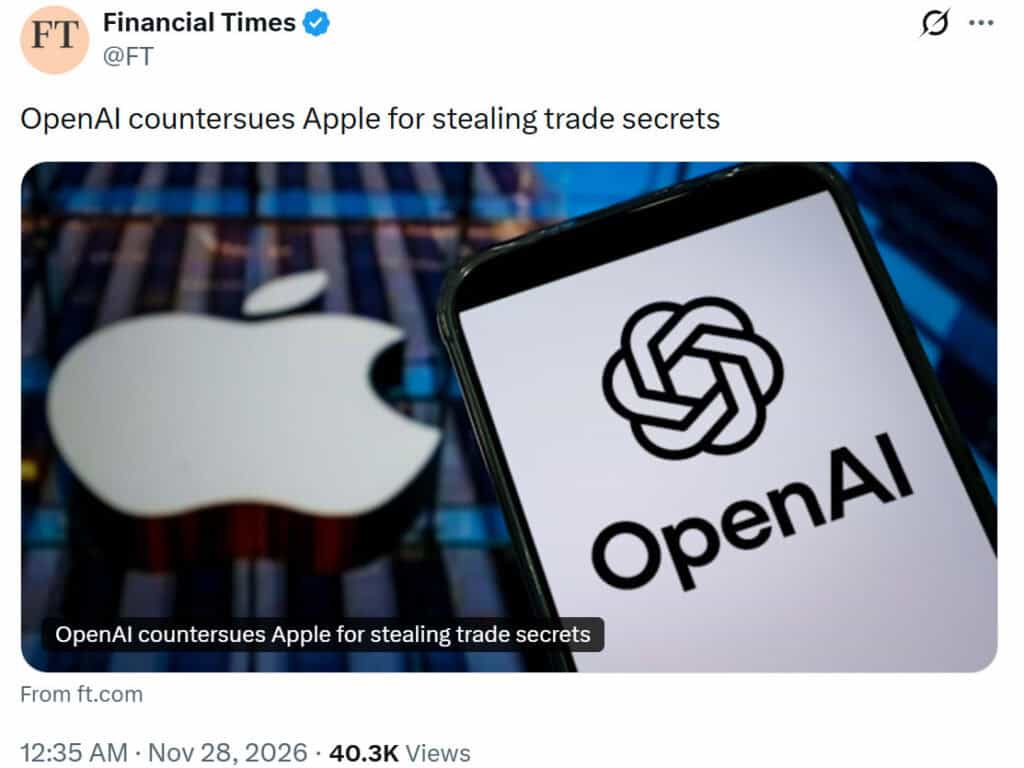
OpenAI has countersued Apple in a California federal court, alleging a former employee leaked trade secrets involving upcoming devices and hardware plans. Source: Financial Times via X
OpenAI claims the employee subsequently shared sensitive details with Apple after rejoining the company. The information reportedly included product development documents and details about OpenAI’s hardware roadmap. The AI company also questioned the employee’s original intentions, arguing that the circumstances suggested obtaining confidential documents may have been a reason for joining OpenAI.
“Given the timing, it now appears that stealing those documents may have been his reason for joining OpenAI in the first place,” the company stated in its filing, according to Reuters.
Apple has denied using the returning employee to obtain OpenAI’s confidential information. It also rejected allegations that it attempted to restrict competition in the AI hardware market.
Supplier Pressure Becomes a Central Part of the Dispute
OpenAI’s counterclaims extend beyond the alleged transfer of confidential information. The company also accuses Apple of using its influence over shared hardware suppliers to obstruct the development and production of OpenAI devices.
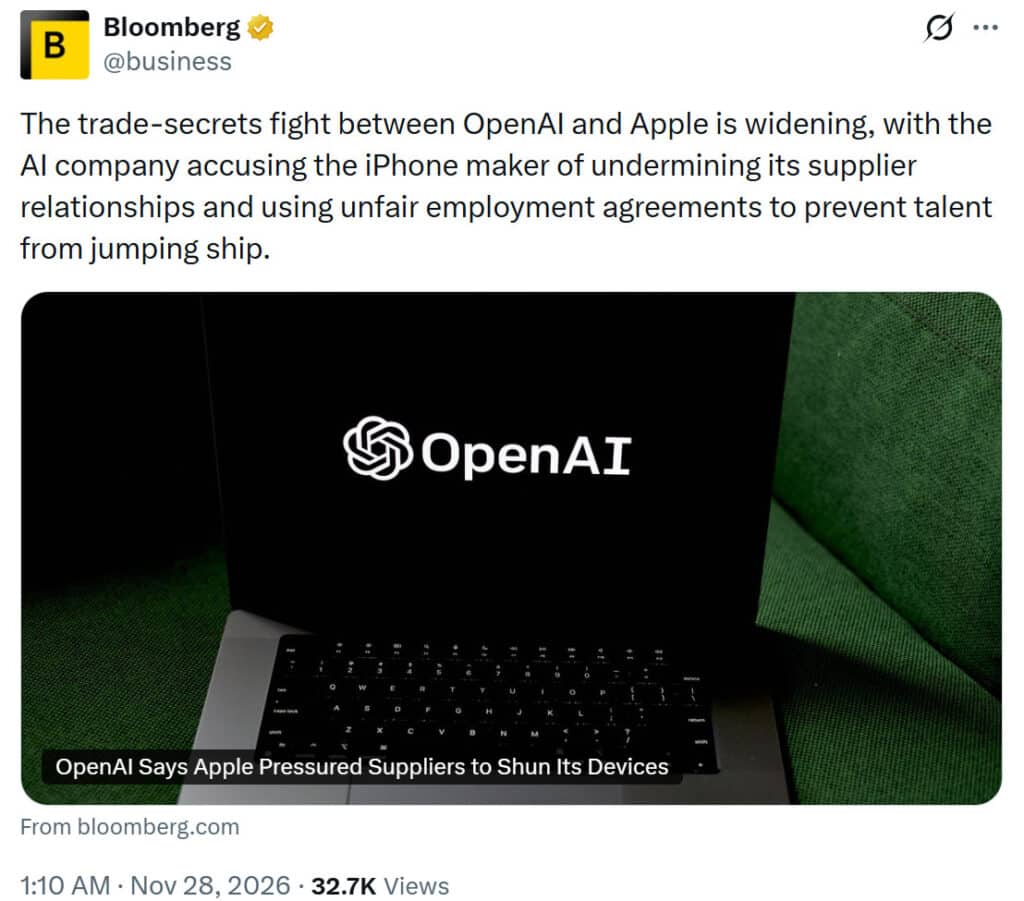
OpenAI has accused Apple of stealing intellectual property, pressuring suppliers against its devices, and using restrictive employment agreements to retain employees in a San Jose federal court countersuit. Source: Bloomberg via X
The filing describes instances in which suppliers allegedly faced pressure over their business relationships with the AI company. OpenAI claims one manufacturer moved its metal-finishing work for OpenAI products to an overnight shift after Apple objected to the supplier handling both companies’ production work in the same area or at the same time. The arrangement reportedly increased operational costs.
OpenAI also alleges that another manufacturer withdrew from planned work after communicating concerns about pressure from Apple. The company claims these supplier-related developments forced it to reconsider parts of its manufacturing arrangements and operational plans.
These allegations highlight the importance of supplier relationships in the consumer electronics industry, where access to specialized manufacturing facilities and production capacity can influence how quickly a company brings new products to market. However, the suppliers involved have not been publicly identified in the reports, and Apple’s alleged conduct has not been established in court.
OpenAI Challenges Apple’s Employment Agreements
The dispute also involves how Apple manages confidential information and employee departures. OpenAI argues that Apple’s intellectual property agreements contain broad restrictions that could make it difficult for former employees to move into competing technology companies.
The AI company alleges that Apple’s employment practices create circumstances in which departing workers and their new employers could face trade-secret accusations. It further claims Apple encourages employees to conduct certain work through personal devices and accounts, then retains access to those resources after their employment ends.
OpenAI describes these practices as creating potential opportunities to monitor former employees and pursue allegations of confidential information theft. The company argues that such arrangements could discourage engineers from accepting positions at competing businesses.
OpenAI also contends that Apple is attempting to discourage its workforce from joining competitors. According to the company’s filing, approximately 400 former Apple employees have joined OpenAI, making employee mobility another important element of the legal dispute.
Apple has characterized the counterclaims as an effort to divert attention from its original lawsuit. The company maintains that its case concerns the alleged theft and use of confidential information belonging to Apple.
Apple’s Original Lawsuit Against OpenAI
Apple initiated the legal dispute on July 10, 2026, filing a lawsuit in the U.S. District Court for the Northern District of California. The complaint named OpenAI and two former Apple employees, Tang Tan and Chang Liu, accusing them of misappropriating proprietary information to support OpenAI’s consumer hardware ambitions.
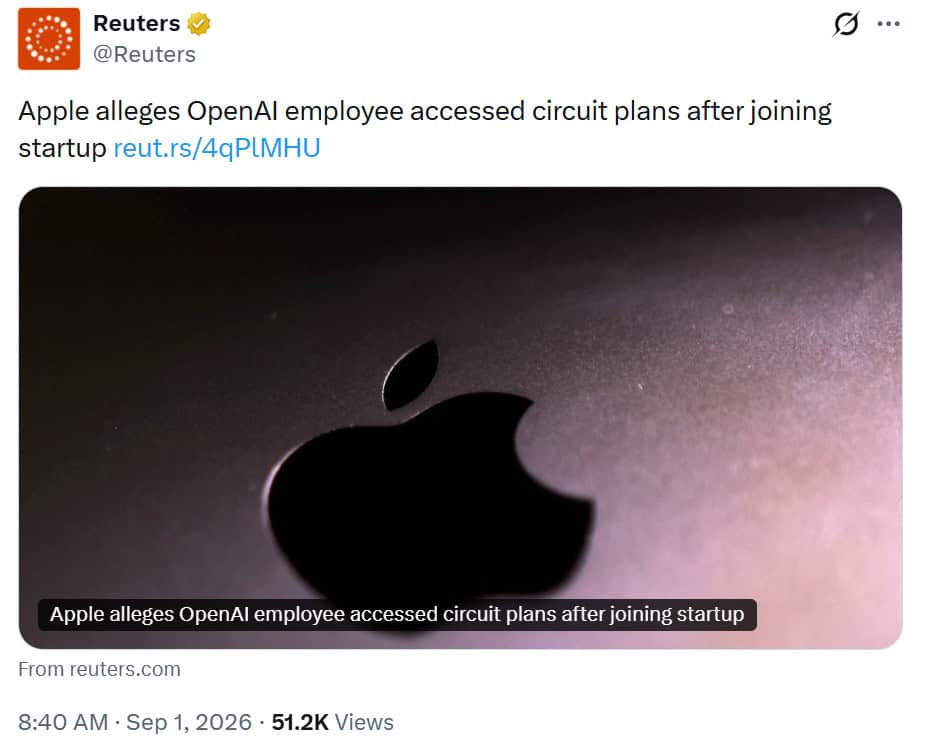
Apple alleges that former engineer Chang Liu downloaded a confidential circuit schematic after joining OpenAI in January 2026 and used it in hardware simulations with tools such as LTspice. Source: Reuters via X
Tan previously worked at Apple for approximately 24 years and held a senior product design role involving the iPhone and Apple Watch. He later became involved with io Products, the hardware startup associated with former Apple design chief Jony Ive, which OpenAI acquired in 2025.
Apple alleged that former employees used confidential product development and supply-chain information to advance OpenAI’s hardware projects. Chang Liu was also accused of accessing proprietary Apple files after leaving the company.
OpenAI and the former employees have rejected Apple’s allegations. They have argued that Apple’s case relies partly on access to Liu’s personal communications and accounts after his departure.
In October, the court granted Apple limited expedited discovery, allowing certain evidence-gathering procedures as the case progressed. That procedural decision did not establish whether either side had misappropriated trade secrets.
AI Hardware Competition Adds Pressure to the Partnership
The legal confrontation comes as OpenAI expands beyond its established software and AI services business. Its acquisition of iOS products in 2025 strengthened its plans to develop consumer hardware, bringing the company closer to Apple’s traditional market.
Apple and OpenAI previously established a partnership to integrate ChatGPT into Apple’s ecosystem. However, OpenAI’s growing hardware ambitions have introduced a competitive dimension to their relationship.
Developing AI-powered consumer devices requires access to specialized engineering expertise, manufacturing partners, and confidential product development processes. Apple’s established position in the hardware industry and OpenAI’s efforts to build its own devices have created overlapping commercial interests.
The competing trade-secret allegations also raise questions about how technology companies protect proprietary information while allowing experienced engineers to move between businesses. Such disputes can affect recruitment, supplier relationships, and product development across the wider technology industry.
Neither company’s allegations have been conclusively established through the court proceedings. The November 27 filing brings OpenAI’s claims directly into Apple’s existing lawsuit, setting the stage for a broader legal examination of confidential information, employee mobility, and competition in the emerging AI hardware market.
 Brave New Coin reaches 1M+ engaged crypto enthusiasts a month through our website, podcast, newsletters, and YouTube. Get your brand in front of key decision-makers and early adopters in 2026. Limited slots remaining! Find out more today!