Anthropic Secures $3.4B Gas Power Deal to Fuel AI Data Centers, IPO Valuation Drops to $1.2T
Anthropic is committing billions to secure its own electricity supply, underscoring how power availability is becoming a defining challenge for artificial intelligence expansion.
The reported $3.4 billion agreement for 1.7 gigawatts of gas-fired generators comes as investors reassess the AI company’s IPO valuation following a sharp technology-stock selloff.
Anthropic Takes Over $3.4 Billion Generator Commitments
Anthropic has reportedly agreed to a $3.4 billion deal with OnePWR Solutions to secure 1.7 gigawatts of gas-fired power generators for its expanding AI data center operations. According to the Financial Times, the agreement was reached in late September and involves taking over existing equipment commitments for Caterpillar generators that the Texas-based supplier had ordered approximately two years earlier.
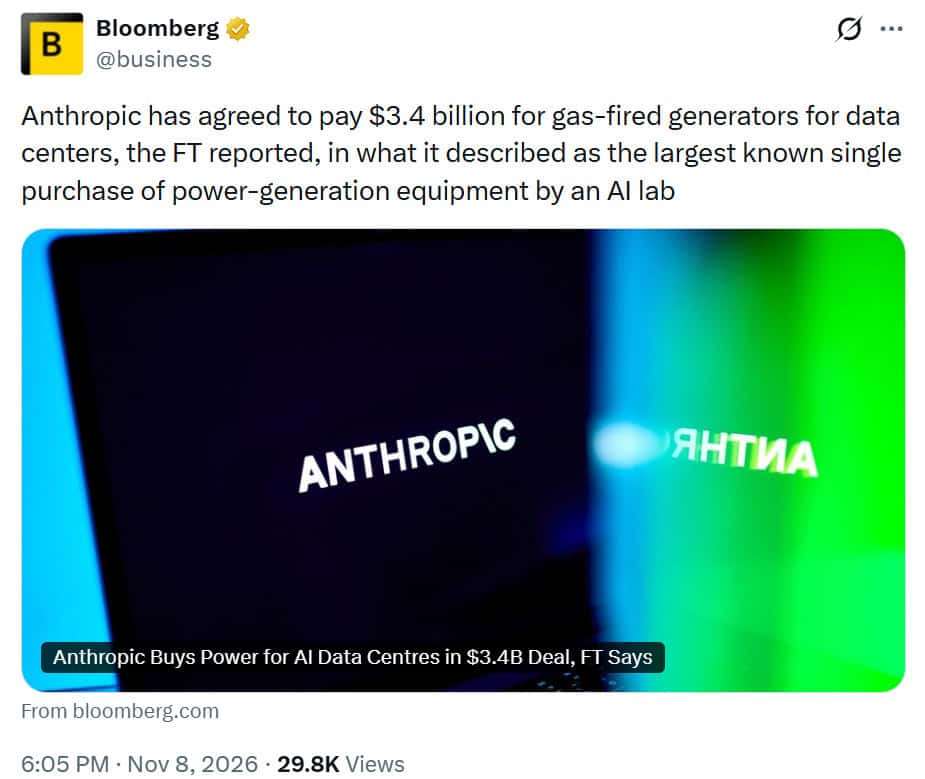
Anthropic secured a $3.4 billion deal with OnePWR Solutions for 1.7 GW of gas-fired generators to power its AI data centers. Source: Bloomberg via X
The transaction also includes engineering and construction capabilities needed to install the equipment. However, Anthropic is not acquiring OnePWR Solutions, and the supplier’s employees are not transferring to the AI company. The arrangement allows Anthropic to secure generators expected to become available soon and over the following two years, addressing supply delays affecting large power-generation equipment.
The Financial Times described the transaction as the largest known single purchase of power-generation equipment by an AI laboratory. The scale highlights how electricity procurement is becoming an essential part of the competition between companies developing increasingly powerful AI models.
Reuters reported the agreement on November 8 but said it could not independently verify the Financial Times report. Anthropic and OnePWR did not respond to requests for comment.
Electricity Shortages Push Anthropic Toward Natural Gas
The generator agreement reflects a growing challenge facing AI companies: securing enough electricity to operate increasingly demanding computing infrastructure. Training and running advanced AI models require large clusters of specialized processors, which consume substantial amounts of power and generate significant cooling requirements.
Anthropic addressed these constraints in its amended Form S-1 registration statement filed with the U.S. Securities and Exchange Commission on November 2. The company identified electricity availability as a significant obstacle to developing and expanding data centers, noting that existing grid infrastructure was not designed to accommodate the rapid growth in AI-related demand.
The filing also explained that building new power-generation capacity, transmission infrastructure, and grid connections can take several years. Consequently, some planned Anthropic facilities will rely on dedicated natural gas-fired generation rather than depending entirely on utility-connected electricity.
The company explicitly acknowledged the financial and operational risks associated with this approach. Its filing stated that on-site natural gas generation exposes the business to “fuel price volatility and supply disruptions” outside its control. Anthropic also warned about pipeline capacity limitations, competition for natural gas supplies, and potential increases in transportation costs.
These arrangements offer a way to secure electricity for facilities where grid connections may not meet the required development schedule. However, they also introduce additional exposure to energy markets, fuel availability, and regulatory requirements.
Anthropic’s Infrastructure Commitments Approach $900 Billion
The generator purchase forms part of a much larger infrastructure expansion. Anthropic disclosed approximately $895.4 billion in aggregate committed spending through its purchase agreements and lease arrangements, substantially related to computing resources and infrastructure.
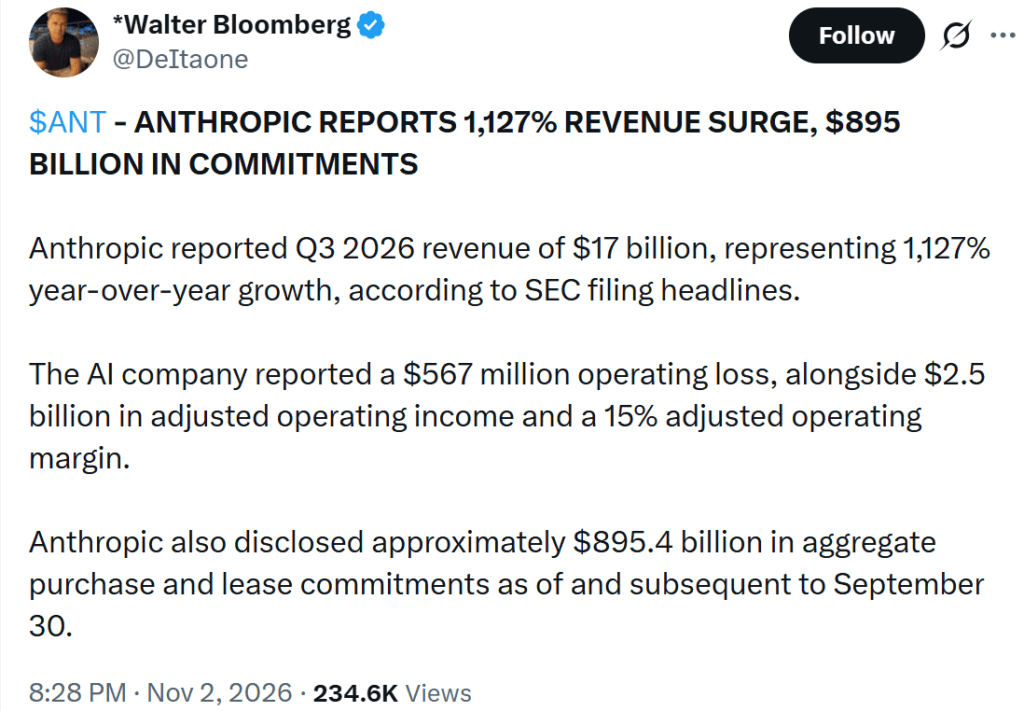
Anthropic disclosed approximately $895.4 billion in combined purchase and lease commitments as of and after September 30. Source: @DeItaone via X
According to the amended SEC filing, approximately $447.5 billion of these commitments are expected to be incurred before December 31, 2030. Most of the remaining obligations are scheduled between 2031 and 2045, while approximately $69.8 billion is due during the 12 months following September 30, 2026.
The company said it intends to fund these investments through operating revenue and capital raised from investors. Its infrastructure strategy includes securing data center capacity while gradually expanding the computing equipment deployed at those facilities.
Anthropic is not alone in facing these challenges. Other AI developers are also responding to growing electricity requirements and public concerns about data center expansion. OpenAI CFO Sarah Friar recently defended the company’s infrastructure plans and pledged to prevent its projects from increasing household electricity bills, as detailed in the report on OpenAI’s data center commitments.
The race for computing infrastructure is also extending beyond electricity procurement. As reported in Brave New Coin’s coverage of Moonshot AI’s Nvidia Blackwell GPU expansion, AI developers are pursuing additional access to advanced processors through international data center operators.
Together, these developments show how AI expansion increasingly depends on securing several interconnected resources, including processors, electricity, cooling infrastructure, and long-term financing.
Anthropic IPO Valuation Expectations Fall to $1.2 Trillion
Alongside its infrastructure expansion, Anthropic is preparing for a potential public-market debut. However, its expected IPO valuation has come under pressure following a substantial selloff across technology stocks.
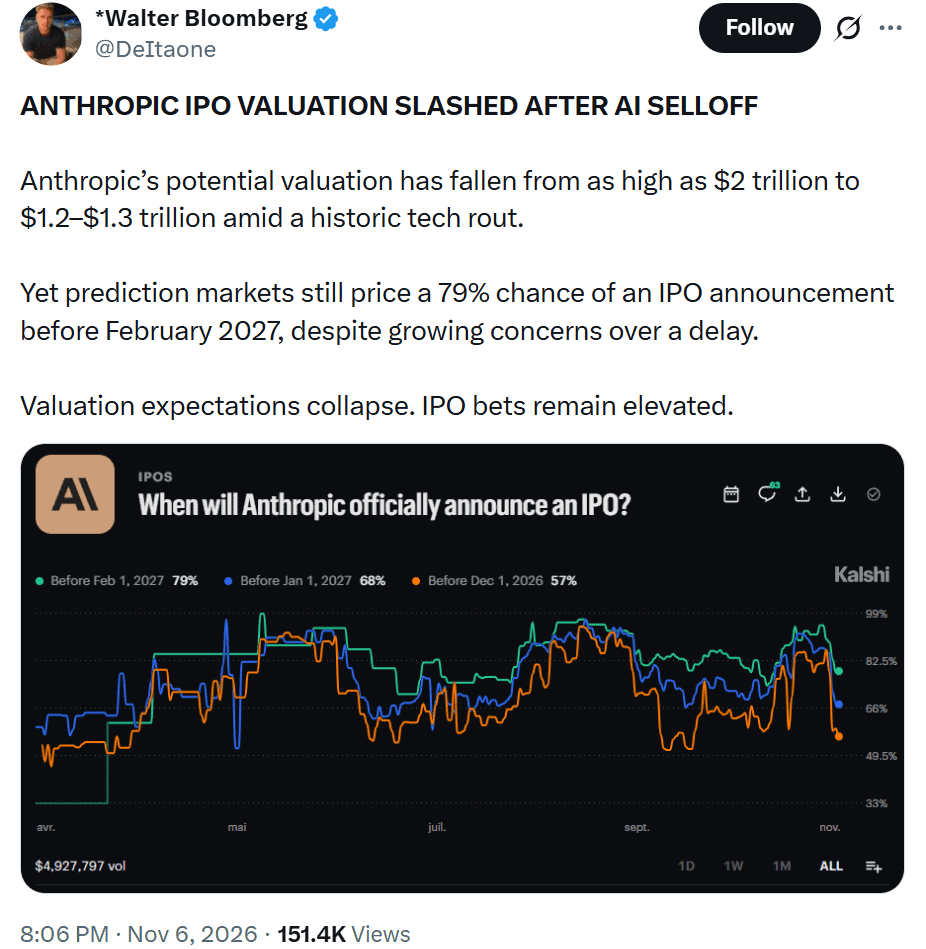
Anthropic’s expected IPO valuation has fallen from nearly $2 trillion to $1.2–$1.3 trillion, amid a post-election AI and technology selloff that wiped trillions off market values. Source: @DeItaone via X
Walter Bloomberg reported on November 6 that prospective investors were discussing a valuation range of approximately $1.2 trillion to $1.3 trillion ahead of formal IPO marketing. Some potential buyers were considering a valuation as low as $1.1 trillion.
The revised expectations represent a significant change from earlier discussions that placed Anthropic’s potential valuation near $2 trillion. Investors had more recently considered a range of approximately $1.4 trillion to $1.5 trillion before the latest market decline altered their assessments.
The Nasdaq 100 fell approximately 6.4% on November 5, wiping out around $2.3 trillion in market value in a single session. The decline intensified concerns about elevated AI-related valuations, rising infrastructure costs, and the financial requirements associated with continued data center construction.
The technology selloff followed the November 3 U.S. midterm elections, adding another layer of uncertainty for companies planning large infrastructure investments. Political pressure surrounding data center development and electricity consumption has also become an important consideration for the technology industry.
For Anthropic, the valuation reset highlights the difference between strong business expansion and the price investors are prepared to pay for future growth. Although its computing capacity and revenue requirements continue to increase, the broader market environment is becoming less supportive of the exceptionally high valuations previously discussed.
Kalshi Traders Maintain Optimism About a Near-Term IPO
Despite the declining valuation expectations, prediction-market participants continue to assign relatively high probabilities to an upcoming Anthropic IPO milestone.
Kalshi’s market tracking the timing of an official IPO confirmation showed an 82% probability of the event occurring before December 1, 2026, as of November 8. The probability increased to 85% before January 1, 2027, and 91% before February 1, 2027.
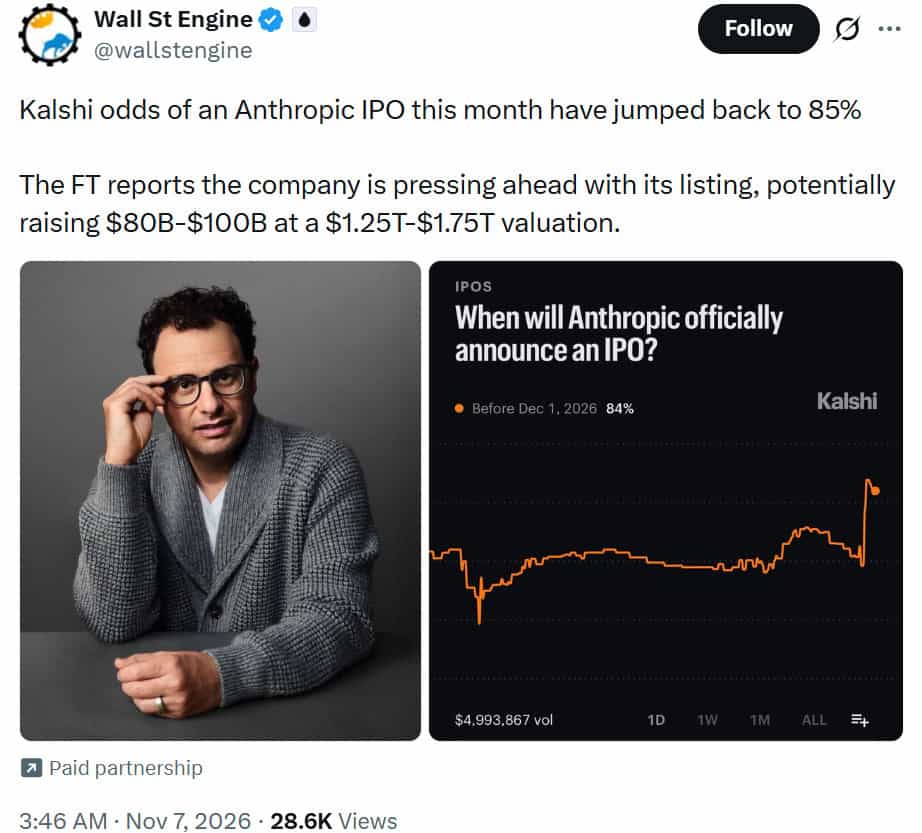
Kalshi’s odds of an Anthropic IPO this month have risen to 85%, as the company reportedly targets an $80–$100 billion raise at a $1.25–$1.75 trillion valuation. Source: @wallstengine via X
These figures reflect market participants’ expectations rather than a confirmed listing schedule. Kalshi’s settlement rules also define an IPO confirmation through specific regulatory or listing milestones, including the SEC declaring the S-1 effective, the IPO being priced, or a securities exchange assigning a ticker.
Anthropic announced on October 26 that it had filed its Form S-1 registration statement with the SEC for a proposed public offering of Class A common stock. The company intends to list on the Nasdaq Global Select Market under the ticker symbol ANT.
However, the initial filing did not establish the number of shares to be offered or the proposed price range. The registration statement must also become effective before the securities can be sold.
Consequently, the high prediction-market probabilities indicate expectations for progress toward the public offering, not confirmation that trading will begin by any particular date.
Revenue Growth Faces a Test From Rising Infrastructure Costs
Anthropic’s financial performance provides additional context for its ambitious spending plans. Its amended SEC filing reported revenue of $33.2 billion for the first nine months of 2026, compared with approximately $2.5 billion during the same period in 2025.
Third-quarter revenue reached approximately $17 billion, reflecting rapidly expanding demand for the company’s Claude models and related products. Anthropic attributed the growth to successive model releases, increased usage, and broader adoption among enterprise customers.
However, operating expenses have also increased significantly. Compute and infrastructure costs reached approximately $18.8 billion during the first nine months of 2026, compared with $4.4 billion in the corresponding period a year earlier.
The company recorded an operating loss of approximately $1.26 billion for the nine-month period, even as adjusted operating income reached $4.1 billion. Its filing also highlighted that additional short-term computing capacity can carry substantially higher costs than longer-term arrangements.
Anthropic’s natural gas generator agreement therefore represents more than an equipment purchase. It is part of a broader effort to secure the physical resources required to support future computing demand while managing the cost and availability of electricity.
The developments also place two different aspects of the company’s growth under scrutiny. Its infrastructure commitments demonstrate the scale of its expansion ambitions, while the lower valuation discussions reflect investors’ changing assessment of the costs, risks, and financial requirements behind the AI industry.
 Brave New Coin reaches 1M+ engaged crypto enthusiasts a month through our website, podcast, newsletters, and YouTube. Get your brand in front of key decision-makers and early adopters in 2026. Limited slots remaining! Find out more today!