Google Launches Gemini 4 Hydrogen With 2.5x Faster Performance, Challenging GPT-6.1 and Claude
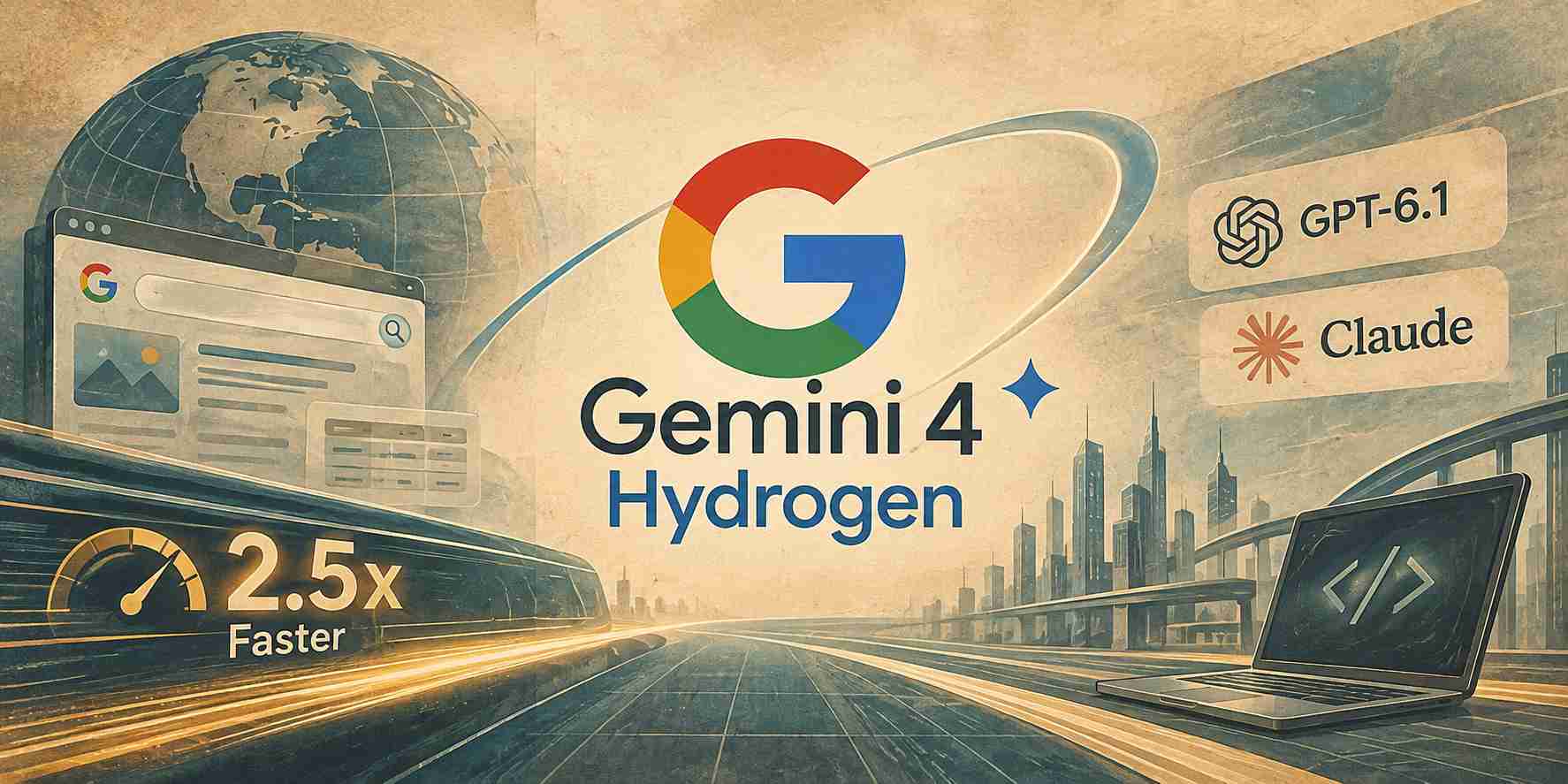
Google has introduced Gemini 4 Hydrogen, a faster and more efficient AI model designed to compete with frontier systems while expanding its presence across search, coding, and agentic workflows.
Announced on November 12, the model brings a reported 2.5x improvement in task completion speed over Gemini 3.8 Flash, alongside stronger coding capabilities and lower execution costs. Google is positioning Hydrogen as an accessible option for developers and businesses that need fast AI execution without relying on its more computationally intensive models.
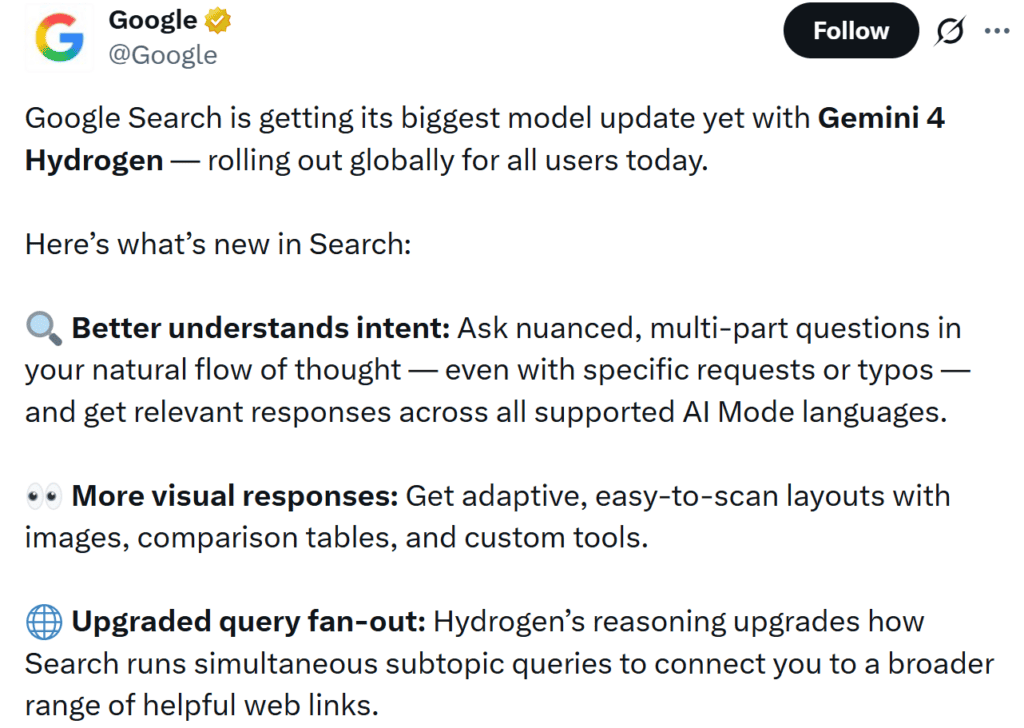
Google announced the global rollout of Gemini 4 Hydrogen, upgrading Search’s intent recognition to better understand complex, nuanced queries, including typos and natural language. Source: Google via X
The release also marks a significant expansion of Google’s Gemini 4 ecosystem, with the model becoming available across Google Search, the Gemini app, AI Studio, and developer platforms. Its benchmark results place it ahead of GPT-6.1 Terra and Claude Sonnet 5.5 in several categories, although competitors retain advantages in other specialized tasks.
Gemini 4 Hydrogen Targets Faster AI Coding and Agentic Workflows
Google DeepMind designed Gemini 4 Hydrogen to handle everyday coding, software development, multimodal tasks, and agentic workflows with greater execution speed. Unlike Gemini 4 Carbon and Gemini 4 Argon, which focus on complex reasoning and longer tasks, Hydrogen prioritizes rapid execution and efficiency.
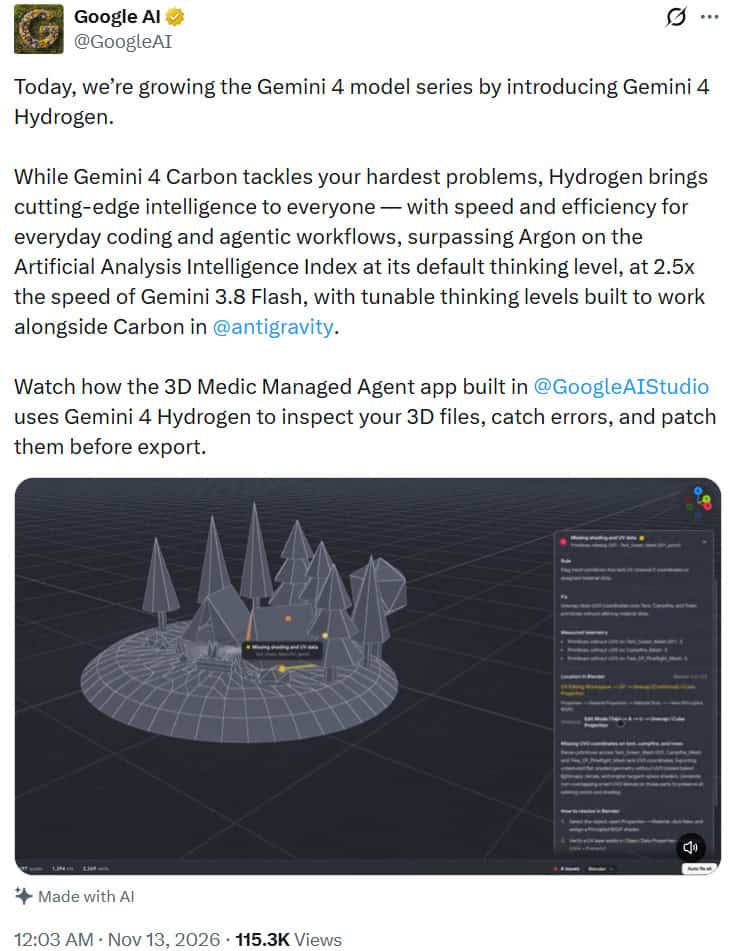
Google introduced Gemini 4 Hydrogen as a fast, efficient model for everyday coding, agentic workflows, and rapid execution, complementing Gemini 4 Carbon’s advanced reasoning capabilities. Source: Google AI via X
According to Google, Hydrogen completes tasks 2.5 times faster than Gemini 3.8 Flash at its default high thinking setting. The company also reported that its Terminal-Bench 4.1 score increased to 57%, compared with 18.2% for its predecessor.
The improvement extends beyond processing speed. Google said Hydrogen reduces fabricated claims by more than five times and handles unsuccessful tool calls or empty search results more effectively. These capabilities are particularly relevant to autonomous AI agents, which must navigate multiple steps, use external tools, and recover from errors without constant human intervention.
The model also introduces four configurable thinking levels, including a new xhigh setting. Users can adjust the reasoning effort according to the complexity of their tasks, balancing response speed against the resources required for more demanding work.
Google DeepMind said Hydrogen also surpassed Gemini 4 Argon on the Artificial Intelligence Index at its default high setting, scoring 51 against Argon’s 50. Its score rises to 54 when using the highest xhigh setting.
Gemini 4 Hydrogen Challenges GPT-6.1 Terra and Claude Sonnet 5.5
Google’s published benchmark evaluations show that Gemini 4 Hydrogen can compete with established frontier models across coding, reasoning, and professional workflows.
In the SWE-sweep evaluation, which measures an AI model’s ability to identify and repair software issues, Hydrogen scored 13.5%. This exceeded Claude Sonnet 5.5 at 3.1% and GPT-6.1 Terra at 5.8%.
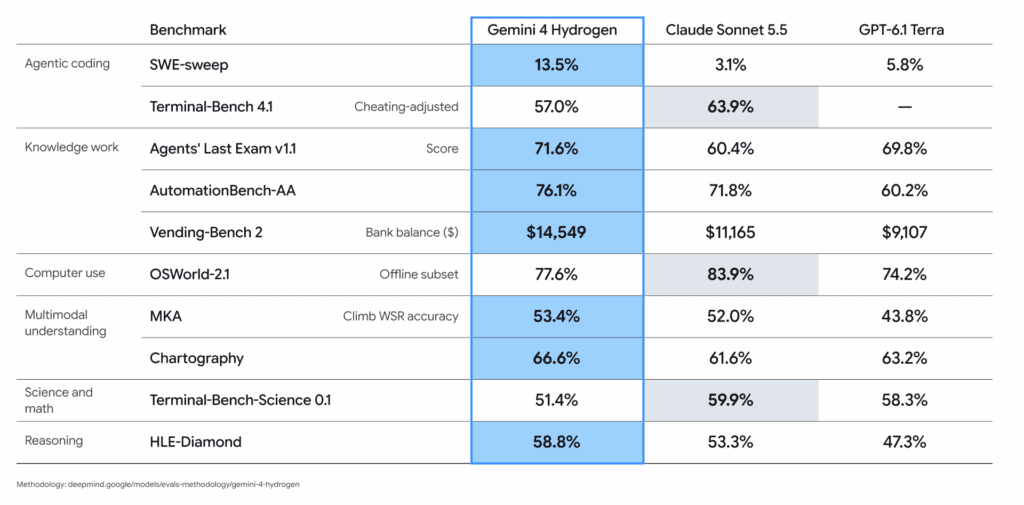
Google DeepMind introduced Gemini 4 Hydrogen as a faster upgrade over Gemini 3.8 Flash, optimized for coding, multimodal tasks, agentic workflows, and everyday use. Source: @GoogleDeepMind via X
Hydrogen also recorded a 71.6% score on Agents’ Last Exam v1.1, ahead of GPT-6.1 Terra at 69.8% and Claude Sonnet 5.5 at 60.4%. The benchmark evaluates how effectively AI systems complete complex professional tasks involving multiple steps and different forms of information.
Its HLE-Diamond score reached 58.8%, compared with 53.3% for Claude Sonnet 5.5 and 47.3% for GPT-6.1 Terra. On AutomationBench-AA, Hydrogen achieved 76.1%, outperforming both competitors in the published comparison.
However, the results do not establish an across-the-board advantage. Claude Sonnet 5.5 scored 63.9% on Terminal-Bench 4.1, above Hydrogen’s 57%. Claude also led the OSWorld-2.1 computer-use evaluation with 83.9%, compared with Hydrogen’s 77.6%.
Google’s evaluation methodology combines its own testing with results reported by competing model providers and public benchmark leaderboards. The company also used different testing configurations across evaluations, making individual benchmark results more useful than treating the overall comparison as a definitive ranking.
Nevertheless, the results demonstrate Google’s progress in making a faster model competitive across several demanding AI applications.
Independent Tests Highlight Gemini 4 Hydrogen’s Cost Advantage
Early demonstrations from independent developers have also drawn attention to Hydrogen’s execution speed and operating costs.
In one comparison shared by developer @EnvolDev, Gemini 4 Hydrogen and Gemini 4 Carbon were assigned the same complex task through OpenRouter using the High setting. Hydrogen completed the task in 1 hour and 23 minutes at a reported cost of $4.27.
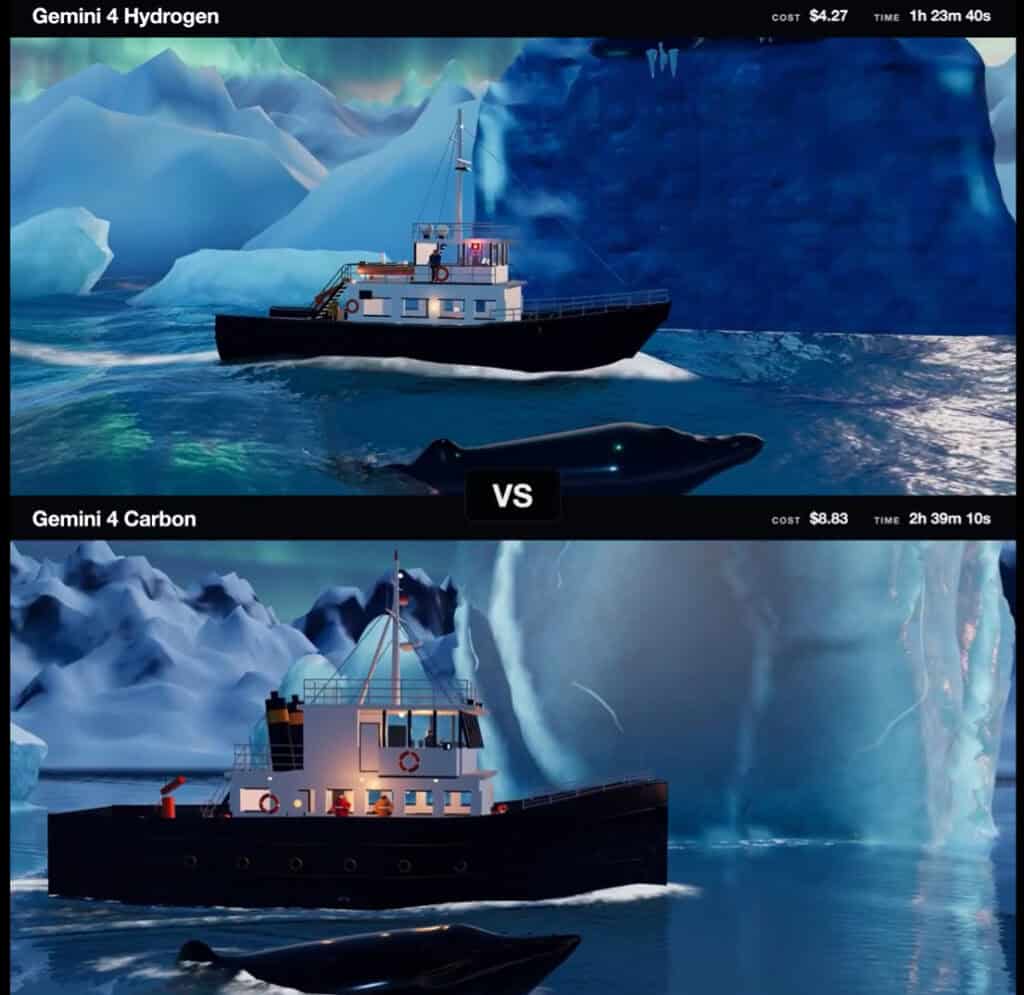
A split-screen video compares Gemini 4 Hydrogen and Carbon generating an arctic boat scene, highlighting Hydrogen’s faster execution and lower cost. Source: @EnvolDev/X
Gemini 4 Carbon took 2 hours and 39 minutes and cost $8.83 to complete the same task. The side-by-side demonstration showed both models generating an arctic boat scene with ice formations and marine elements.
Although this was an individual test rather than a standardized benchmark, the results highlight the potential cost and time advantages of using Hydrogen for workloads that do not require the deeper reasoning capabilities of Carbon.
A separate demonstration shared by @AI_Screening compared Gemini 4 Hydrogen, Carbon, and Argon in AI video generation. The models generated a stylized horse galloping across a savanna at sunset, allowing viewers to compare motion quality, environmental effects, and visual consistency.
Hydrogen delivered competitive animation quality in the demonstration while offering faster generation and lower costs. These results suggest that the model could provide an efficient option for certain multimodal creative workflows, although individual demonstrations do not establish consistent performance across different prompts and generation tasks.
Google Upgrades Search With Gemini 4 Hydrogen
Alongside the model launch, Google has introduced a significant upgrade to Google Search, integrating Gemini 4 Hydrogen to improve how the platform understands and responds to complicated queries.
The November 12 rollout allows Search to interpret more nuanced, multi-part questions, including requests written in natural language or containing difficult-to-understand typos. The system is designed to identify the user’s intent more accurately rather than relying solely on individual keywords.
Google has also improved its query fan-out capabilities. The technology allows Search to explore several related subtopics simultaneously, connecting users with a wider selection of relevant websites and information sources.
The updated experience introduces more adaptive visual responses, including images, comparison tables, structured information, and custom tools. These features are intended to make complicated searches easier to understand without requiring users to navigate multiple pages manually.
Robby Stein, Google’s vice president of product for Search, described the release as the biggest model upgrade to Search yet. He said the update would help users find relevant information through more intuitive and visually structured responses.
Google also highlighted improvements to language understanding across supported AI Mode languages, extending the upgraded search experience to users making queries in different languages.
The integration is particularly important for Google’s broader AI strategy because it brings Gemini’s reasoning and information-processing capabilities directly into one of the company’s most widely used products.
Gemini 4 Hydrogen Expands Across Google’s AI Ecosystem
Google is making Gemini 4 Hydrogen available across its consumer, developer, and enterprise platforms, increasing access to its latest AI capabilities.
Developers can use the model through the Gemini API, Google AI Studio, and Android Studio. Businesses can also access it through Gemini for business and supported enterprise tools, while general users can find Hydrogen in the Gemini app and Google Search.
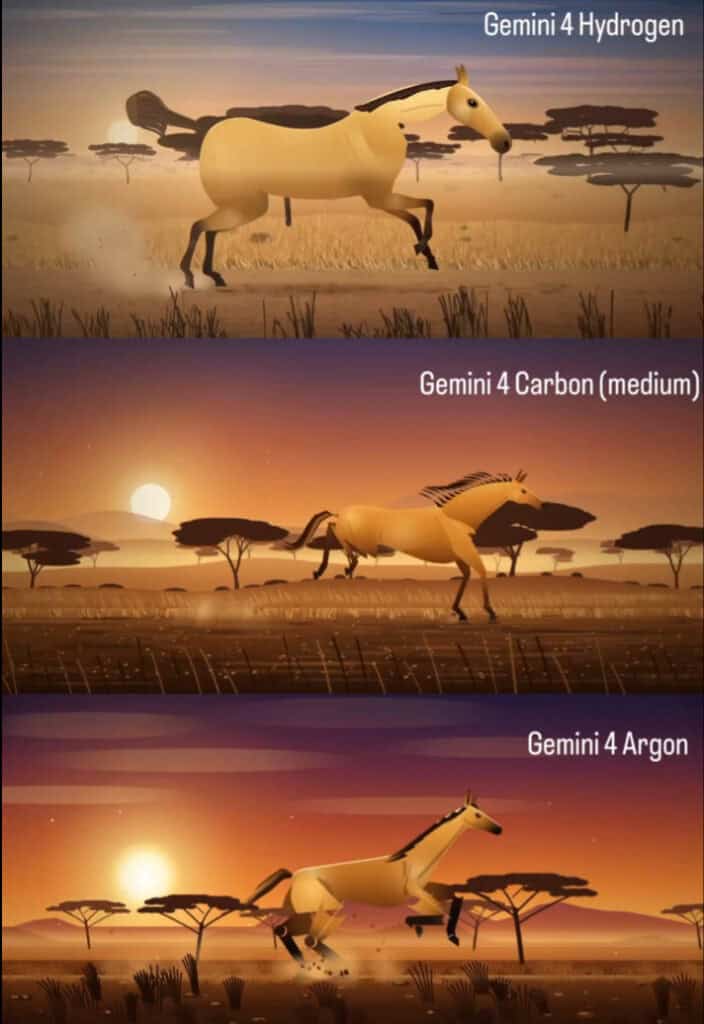
A split-screen comparison evaluates Gemini 4 Hydrogen, Carbon (Medium), and Argon in generating a galloping horse scene, highlighting differences in motion quality, dust effects, and visual consistency. Source: @AI_Screening/X
Google is also introducing a multi-model approach through its Antigravity development platform. Its Orchestrator feature can dynamically switch between Gemini 4 Carbon and Hydrogen during a single session, assigning more complex reasoning tasks to Carbon and faster execution work to Hydrogen.
According to Google, this approach achieved near-Carbon task success rates on Terminal-Bench 4.0 while using 24% less quota and completing tasks 19% faster on average.
The model’s API pricing is set at $1.50 per million input tokens and $7.50 per million output tokens across its one-million-token context window. This gives developers a defined cost structure when integrating Hydrogen into applications and automated workflows.
By combining configurable reasoning, faster execution, and multi-model coordination, Google is targeting users who need to manage increasingly complex AI workloads without relying exclusively on its most resource-intensive systems.
Google’s AI Competition Intensifies
The launch of Gemini 4 Hydrogen strengthens Google’s position in an increasingly competitive AI market, where model performance is no longer measured solely by reasoning capabilities.
Speed, inference costs, coding accuracy, and the ability to complete multi-step tasks have become important factors for developers and businesses choosing AI systems. Google’s latest release addresses these requirements while extending its Gemini technology into Search and everyday productivity tools.
Its benchmark performance against GPT-6.1 Terra and Claude Sonnet 5.5 provides evidence of progress in several categories, although differences in computer use and terminal-based tasks show that competitors remain competitive.
The introduction of Hydrogen also reflects a broader shift toward specialized AI models that can handle routine execution more efficiently while working alongside larger systems for demanding reasoning tasks.
As Google expands access to Gemini 4 Hydrogen, its ability to maintain benchmark performance while delivering measurable savings in execution time and costs will be an important factor in determining its adoption among developers, enterprises, and everyday users.
 Brave New Coin reaches 1M+ engaged crypto enthusiasts a month through our website, podcast, newsletters, and YouTube. Get your brand in front of key decision-makers and early adopters in 2026. Limited slots remaining! Find out more today!