JPMorgan and DBS Take Dollar Transfers Into the Weekend—With One Important Catch

JPMorgan and DBS have connected their tokenized deposit networks for round-the-clock dollar transfers. The launch shows banks putting blockchain to work, while a Saturday maintenance window reveals where the older system still matters.
JPMorgan and DBS have connected their blockchain deposit networks so institutional clients can move tokenized U.S. dollars between Singapore and the United States around the clock, including weekends.
The November 16 launch announcement names Ant International as the first client. It is a concrete move from planning to commercial availability for a form of digital money that keeps banks at the centre of the transaction.
The appeal is straightforward: businesses operate across time zones even when conventional banking processes pause. But the service also exposes a boundary in the always-on promise—moving money between JPMorgan’s legacy deposit accounts and blockchain accounts still has a Saturday interruption.
What JPMorgan and DBS have actually launched
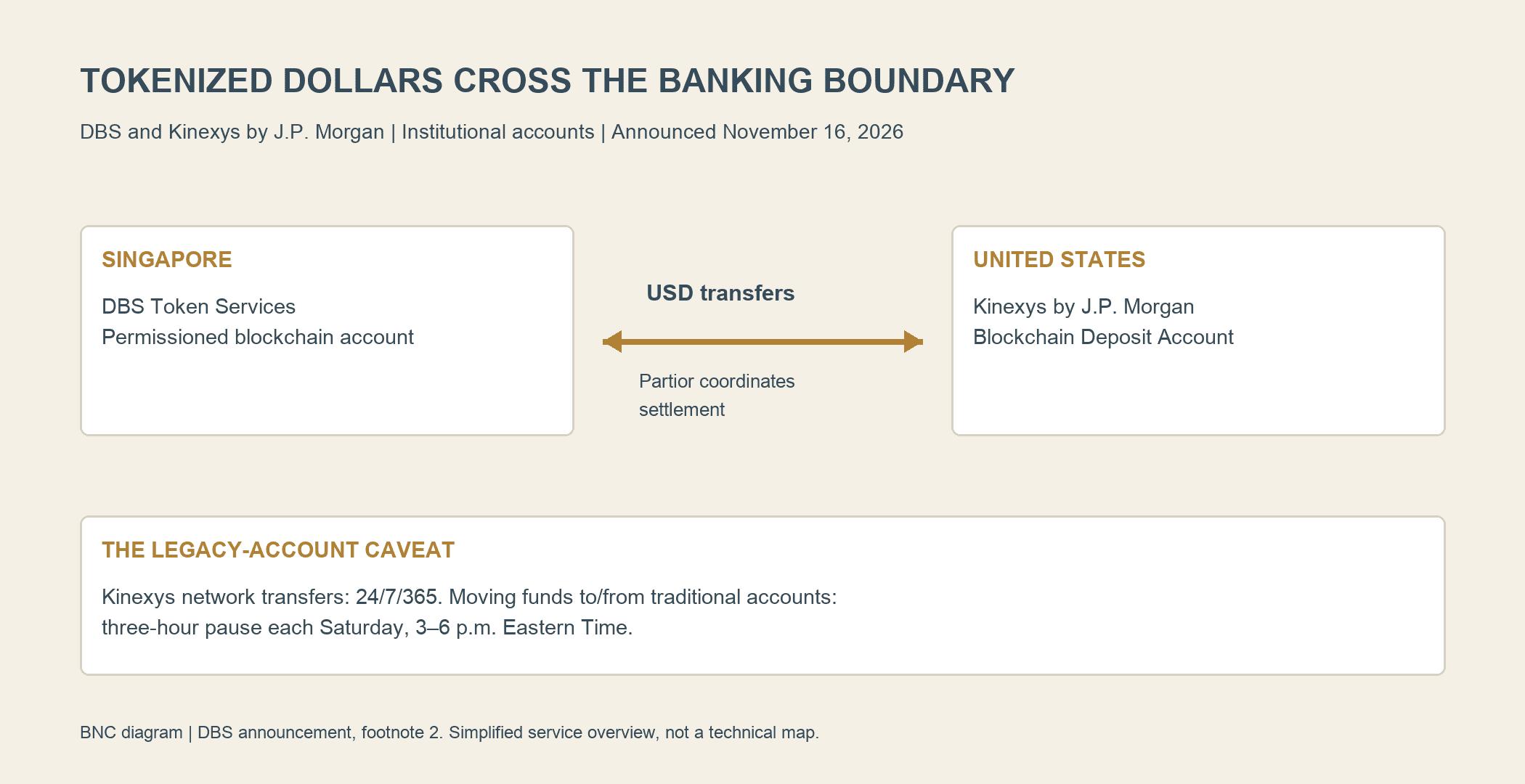
The link joins DBS Token Services with Kinexys by J.P. Morgan’s account-based permissioned deposit network. Partior coordinates settlement. The stated use case is institutional dollar liquidity between accounts in the two markets.
Rachel Chew, DBS’s chief operating officer and co-head of digital assets for global transaction services, said tokenized money was moving towards “delivering live tangible value for clients.”
The announcement’s footnote qualifies the operating hours. Transfers within the Kinexys blockchain account network run continuously, but moving funds between those accounts and traditional demand deposit accounts pauses from 3 p.m. to 6 p.m. Eastern Time each Saturday. DBS says an enhancement is being developed.
Why the account boundary matters
For a treasury team, money already inside the relevant network and money still sitting in a conventional account are different operational starting points. An available transfer route is useful only if the funds can reach it when needed.
Consider a hypothetical business that expects a weekend funding requirement. Keeping suitable liquidity in the supported account beforehand could make the new connection valuable. Leaving everything outside it until the maintenance window would raise a different question.
That does not negate the service’s usefulness. It shows why companies need to assess the whole payment journey: funding, transfer, receipt and the recipient’s ability to use the balance. Speed in one stage cannot answer every question about the others.
Likewise, a transfer completing across this link does not establish that every unrelated supplier can receive an immediate conventional bank payment. Eligibility, account access and onward payment arrangements remain relevant.
A year-old framework becomes a working connection
The banks’ November 2025 framework announcement described plans to connect their separate on-chain ecosystems. At the time, each already offered round-the-clock capabilities within its own environment.
The proposed next step was exchangeability and settlement across the two systems, with ambitions spanning public and permissioned blockchains. The newly announced service should be judged on its specified permissioned-account connection, rather than assuming every part of that broader ambition is now available.
This is the interoperability problem in practical terms. A fast network inside one bank has limited reach if customers cannot readily transact with another bank’s network. Connecting institutions can be more useful than making an already quick internal transfer slightly faster.
Tokenized deposits keep the bank in the picture
DBS describes Token Services as a suite of blockchain banking capabilities covering programmable value transfers, liquidity management and payment controls. Its proposition is an extension of banking services using tokenization and smart contracts.
A tokenized bank deposit remains a claim associated with a bank account. It differs from simply acquiring a freely circulating cryptocurrency for a personal wallet. The relevant questions include which institution owes the money, who may participate and how transfers are governed.
For stablecoin issuers, that creates competition over a particular job: moving digital dollar value when customers need it. It does not mean one launch replaces the many uses of public-chain stablecoins or creates demand for every blockchain token.
The commercial contest will turn partly on reach. A corporate service can be attractive within an approved banking relationship while serving a different customer from someone seeking an open wallet-to-wallet payment.
For an institution choosing between these routes, the useful comparison is total cost, availability and operational fit. A familiar bank relationship could matter as much as the underlying ledger technology.
Singapore’s wider plan includes AI payments
The Monetary Authority of Singapore’s Project BLOOM sets out a wider effort to improve domestic and cross-border settlement. It includes regulated stablecoins and tokenized commercial-bank money, alongside interoperability and programmable controls.
Its focus areas also include payments by AI agents within predefined limits and safeguards. That is a policy and development direction, not a claim that the new DBS–JPMorgan link has already enabled autonomous consumer spending.
BNC’s report on AI agents paying for computing with Bitcoin examined another route towards automated transactions. Together, the developments show why payment infrastructure matters to AI as well as finance: software needs both authority to spend and a way to settle.
The next test for the banks is sustained customer usage, broader connectivity and fewer interruptions at the boundaries. The launch provides a specific new dollar route. Its significance will grow if companies can use it reliably as part of everyday cash management.
 Brave New Coin reaches 1M+ engaged crypto enthusiasts a month through our website, podcast, newsletters, and YouTube. Get your brand in front of key decision-makers and early adopters in 2026. Limited slots remaining! Find out more today!