The Trades Your Algorithm Rejects May Be the Most Important Data You Never Measure

Most trading systems are very good at remembering what they bought. They record entry prices, exits, profits, losses, holding periods and dozens of other variables. When a trade succeeds, analysts can study why. When it fails, they can study that too. But there is another group of decisions that often disappears almost completely: the trades the system rejected.
That creates an important blind spot.
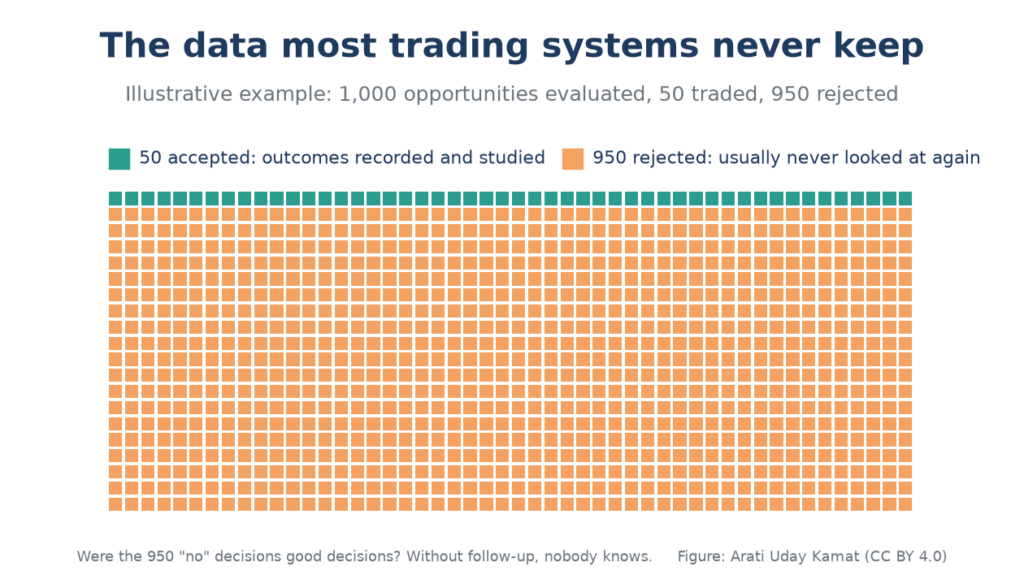
Imagine an automated crypto trading system evaluates 1,000 possible opportunities and rejects 950 of them. It executes only 50 trades.
The developer can carefully analyse the performance of those 50 trades. But that still does not answer a basic question:
Were the other 950 rejections good decisions?
A filter may appear to protect a trading system because the trades it accepts perform reasonably well. But without observing what happened after rejection, nobody can know how many losses the filter successfully avoided or how many potentially profitable opportunities it discarded.
This problem became increasingly important to me while studying algorithmic decision-making on decentralised exchanges.
Rejection is also a decision
A trading system does not make decisions only when it buys or sells.
Choosing not to trade is also a decision.
Suppose a token is rejected because its liquidity is too low. Another is rejected because of wallet concentration. A third fails a momentum threshold.
Twenty-four hours later, the first token collapses, the second becomes inactive and the third rises sharply.
Those outcomes contain information about the filters that made the original decisions.
But if the system stopped observing each token at the moment it rejected it, that information has been lost.
This creates an asymmetry in the data.
Accepted decisions naturally generate histories because capital is attached to them. Rejected decisions can disappear from the record even though they may greatly outnumber accepted ones.
I wanted to measure that missing side of the decision process.
Following what the algorithm rejected
I developed Post-Rejection Follow-up Sampling, or PRFS, as a framework for doing this systematically.
The basic idea is simple.
When an algorithm rejects a candidate, do not throw the candidate away.
Record the decision and continue observing the asset.
The process can preserve the time of rejection, the reason for rejection, the market conditions visible at that moment and subsequent observations at predefined intervals.
The order matters.
The decision comes first. The subsequent market path is observed afterward.
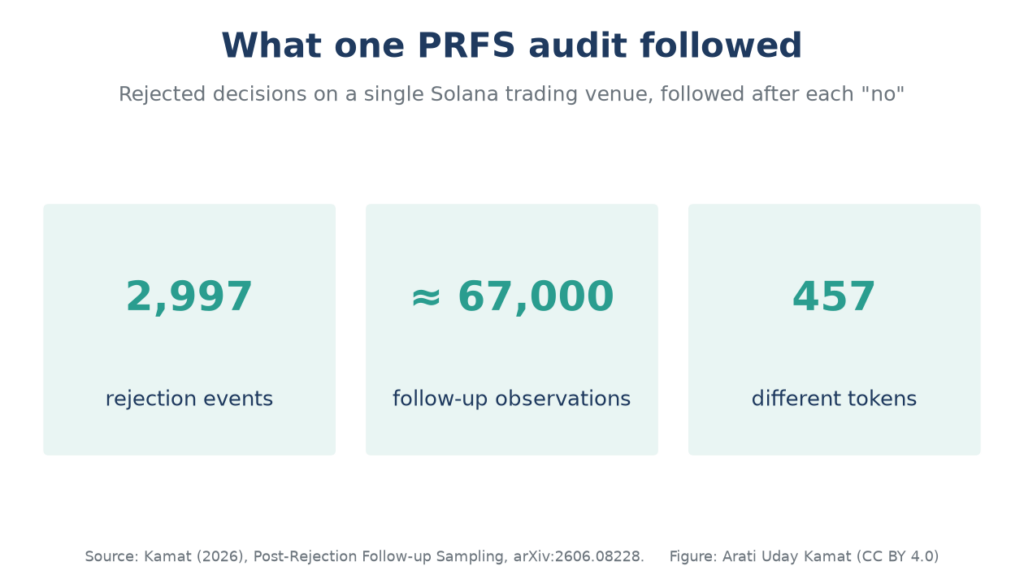
In my PRFS audit, the dataset contained approximately 67,000 forward observations associated with 2,997 rejection events involving 457 unique token mints.
The audit also exposed another important lesson.
Collecting more data does not automatically solve a measurement problem.
The identity of the decision being followed, the timing of observations and the way those observations are connected back to the original rejection all matter.
A large dataset can still answer the wrong question if those relationships are incorrectly recorded.
Making rejected decisions measurable
I also developed RED-2400, a public benchmark designed around algorithmically rejected trading events.
The objective was not to produce another trading strategy or claim that one filter could predict token prices.
It was to make the rejected side of the decision process observable.
Once that information exists, researchers can ask much better questions.
Did a particular filter mostly reject assets that subsequently deteriorated?
Did it repeatedly discard assets that later appreciated?
Did its effectiveness change under different market conditions?
Are several filters rejecting essentially the same population for different reasons?
And perhaps most importantly:
Is a trading system being improved based only on the small fraction of opportunities that the system itself made observable?
Independent developers are beginning to test the idea
One of the most encouraging developments has occurred outside my own research.
Independent developers have since built rejection follow-up ledgers and related post-rejection tracking into their own systems.
Some have created persistent ledgers for rejected signals rather than allowing those decisions to disappear from process memory. Others have implemented post-rejection trackers that continue observing rejected candidates at predefined intervals so that screening rules can later be evaluated against what actually happened.
Other independent researchers have used public data from my work to investigate selection and survivorship bias in their own trading datasets and strategy experiments.
This matters to me because research becomes much more informative when someone other than its author tries to use it.
An external implementation can expose limitations, reveal new applications and sometimes show that an apparently promising strategy should not be deployed at all.
That last outcome deserves more attention.
Sometimes the valuable result is deciding not to trade
Financial research is often presented as valuable when it discovers something profitable.
But identifying something that should not be deployed can also have economic value.
Suppose a strategy looks profitable in historical data.
A broader dataset then reveals that successful assets were disproportionately represented in the original sample. Or a more realistic replay shows that the apparent advantage disappears after transaction costs.
The useful result is no longer a profitable backtest.
The useful result is avoiding a potentially bad decision.
This is especially important in fast-moving crypto markets, where small samples, changing liquidity and selection effects can produce attractive historical results that may not survive real-world conditions.
A system capable of discovering evidence against its own decisions may ultimately be more useful than one designed only to find apparent winners.
This problem extends beyond crypto
Reject-side measurement is not only a cryptocurrency problem.
Consider credit underwriting.
A lender naturally observes repayment performance for approved borrowers. The outcomes of rejected applicants are much harder to observe under the same lending decision.
Consider fraud detection.
Cases that pass through later stages of investigation may generate rich labels, while cases removed earlier in the pipeline can receive much less follow-up.
Similar problems can appear in insurance, risk screening, recommendation systems and other machine-learning applications.
The details differ, but the underlying problem is related.
Automated systems increasingly filter large populations before taking action on a much smaller subset.
If researchers evaluate only the population that survives those filters, they may end up evaluating a population partly created by the system itself.
Build systems that remember their “no”
As financial systems become more automated, I believe their audit trails should preserve more than executed actions.
Rejected decisions should become first-class data.
What did the system see?
Why did it say no?
What happened afterward?
Was the rejection ultimately consistent with the system’s objective?
And does the same rule continue to behave similarly when market conditions change?
These questions become even more important as financial decision-making moves toward machine-learning models and increasingly autonomous agents.
A trading algorithm that records only its trades remembers what it did.
A system that also follows its rejections can begin to measure whether its decisions were actually useful.
The data currently discarded may contain some of the most important information about whether automated financial systems deserve confidence.
This article is for information only and is not investment advice.
Research links
Post-Rejection Follow-up Sampling (PRFS): arXiv:2606.08228
RED-2400: arXiv:2605.12151
About the author
Arati Uday Kamat is an independent researcher working on algorithmic decentralised-exchange trading, reject-side outcome measurement and financial-system evaluation. Her research includes Post-Rejection Follow-up Sampling (PRFS), arXiv:2606.08228, and RED-2400, arXiv:2605.12151, a public benchmark for studying rejected trading decisions.
 Brave New Coin reaches 1M+ engaged crypto enthusiasts a month through our website, podcast, newsletters, and YouTube. Get your brand in front of key decision-makers and early adopters in 2026. Limited slots remaining! Find out more today!