Nvidia AI Chip Restrictions Expand as US Closes Cloud Computing Loophole for China

The United States is tightening restrictions on advanced AI chip exports, targeting overseas data centers that allow Chinese companies to access restricted computing power remotely.
The Commerce Department’s latest measures extend existing semiconductor controls to cloud infrastructure, adding pressure on Nvidia’s international supply chain and escalating tensions between Washington and Beijing.
US Targets Remote Access to Advanced AI Chips
The US Department of Commerce’s Bureau of Industry and Security (BIS) announced an interim final rule on November 16, 2026, aimed at preventing companies in China and other restricted jurisdictions from accessing advanced American computing technology through overseas data centers.
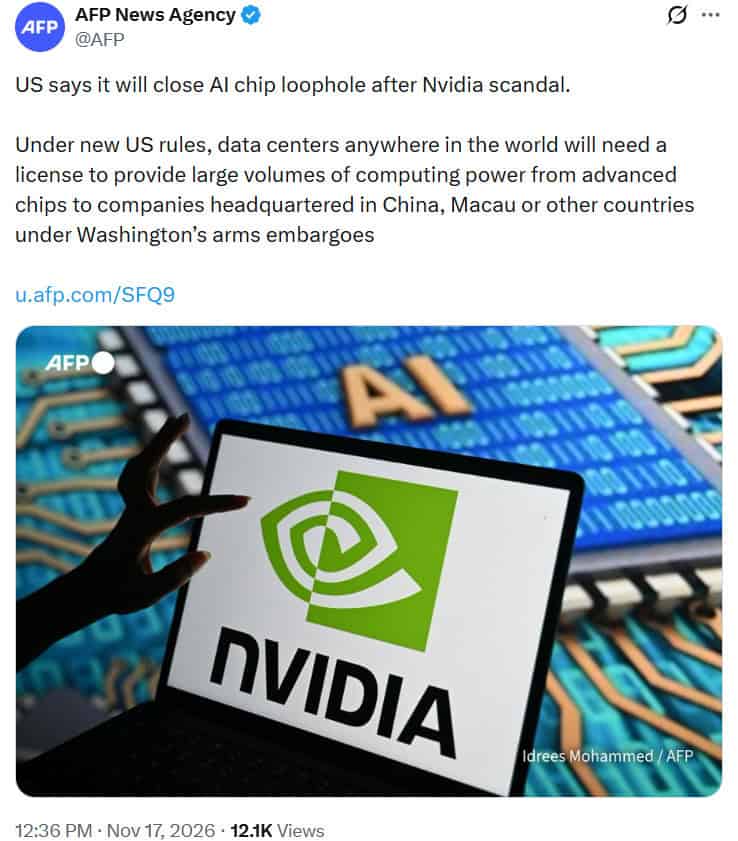
The US is tightening controls on remote access to advanced AI chips by Chinese firms through overseas data centers. Source: @AFP via X
Previously, US export controls primarily focused on the physical shipment of advanced semiconductors. However, companies could potentially bypass these restrictions by renting computing capacity from data centers operating in countries outside the direct scope of the controls.
The new rule addresses this gap by requiring licenses for exports, reexports, or domestic transfers of covered advanced semiconductors and related equipment intended for data centers providing significant computing capacity to companies headquartered in China, Macau, or other designated restricted jurisdictions.
The regulation establishes a threshold of 12 million aggregate Total Processing Performance (TPP) for computing access across individual or digitally connected data centers. It also covers indirect arrangements involving third-party operators and intermediaries.
Under the new requirements, data center operators, foreign chip manufacturers, and exporters must conduct customer due diligence to identify the ultimate users of advanced computing infrastructure. This includes examining direct and indirect ownership structures to determine whether restricted entities control or benefit from the services.
The BIS said the measure would ensure existing restrictions could not be circumvented through remote computing arrangements involving data centers in third countries.
Five Countries Face Additional Export Licensing Requirements
The US has also expanded its export licensing requirements to five countries identified as higher-risk destinations for semiconductor diversion.
The list includes Singapore, Malaysia, Thailand, Indonesia, and Brazil. Companies exporting, reexporting, or transferring covered advanced semiconductors to these markets will face additional licensing requirements under the updated framework.
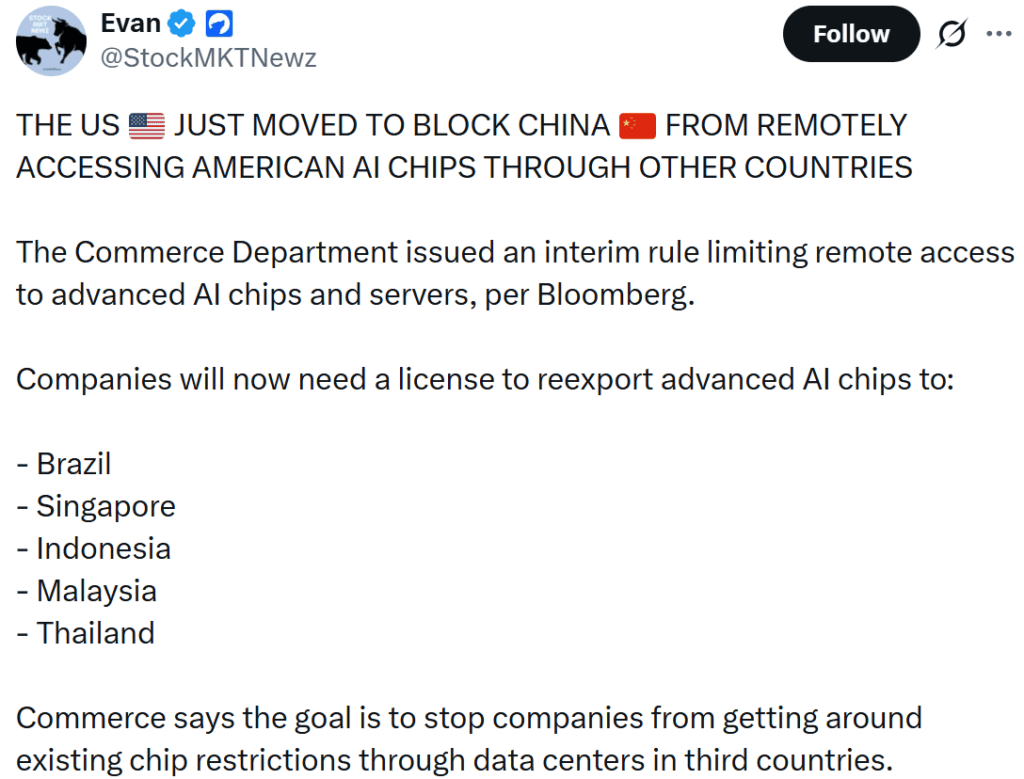
The US is tightening AI chip export controls, requiring licenses for transfers to high-risk countries and setting a 12 million TPP computing threshold for data centers serving restricted entities. Source: @StockMKTNewz/X
The decision reflects concerns that restricted chips could reach unauthorized destinations through intermediaries, overseas cloud providers, or complex supply-chain arrangements.
However, the rules include an exception for shipments intended for companies headquartered in the United States or whose ultimate parent companies are based there, provided exporters meet the applicable reporting requirements.
Existing overseas data centers that already provide significant computing capacity to restricted companies will have 90 days from the rule’s effective date to obtain the necessary licenses if they intend to continue those services.
The regulation also excludes commercial recommendation systems used by online retailers and social media platforms, provided they meet the specific requirements. These systems generally rank, filter, or recommend products and content rather than generate new AI models or content.
The measures are part of a broader effort to extend US export controls beyond physical semiconductor shipments and cover the computing infrastructure that enables advanced AI development.
Megaspeed Investigation Adds Pressure on Nvidia
The regulatory changes follow growing scrutiny of Singapore-based cloud computing company Megaspeed International, which has been investigated over suspected violations of US semiconductor export controls.
The US Commerce and Justice departments confirmed on November 16 that the investigation began in 2024 after authorities identified suspicious activity involving potential semiconductor diversion.
According to their joint statement, Commerce investigators requested records from Nvidia in May 2025 concerning direct or indirect sales to Megaspeed. Nvidia subsequently placed the company on its internal no-sell list in June 2025.
US investigators, working alongside Singaporean law enforcement officials, conducted an on-site inspection at Megaspeed that same month and interviewed its then-chief executive, Alice Huang. The Justice Department later assumed the lead role in the criminal investigation.
The case attracted additional attention following reports about Alice Huang’s relationship with Nvidia co-founder Jensen Huang and allegations concerning her possible links to Chinese intelligence. Those allegations have not been established as criminal findings in the government’s public statement.
Jensen Huang stepped down as Nvidia’s chief executive on November 12, 2026, amid growing scrutiny surrounding the controversy.
The investigation has highlighted how overseas cloud infrastructure can potentially provide access to advanced Nvidia processors without requiring restricted chips to be physically shipped into China.
The latest Commerce Department measures directly address this type of arrangement by extending licensing requirements to data centers that provide computing capacity to restricted customers.
China Warns of Countermeasures as AI Trade Tensions Escalate
Beijing has strongly opposed Washington’s latest export restrictions, warning that it could introduce countermeasures if the United States proceeds with the new controls.
China’s Commerce Ministry said on November 17 that it firmly opposed the measure, arguing that it further restricts Chinese companies’ access to advanced AI chips from manufacturers such as Nvidia.
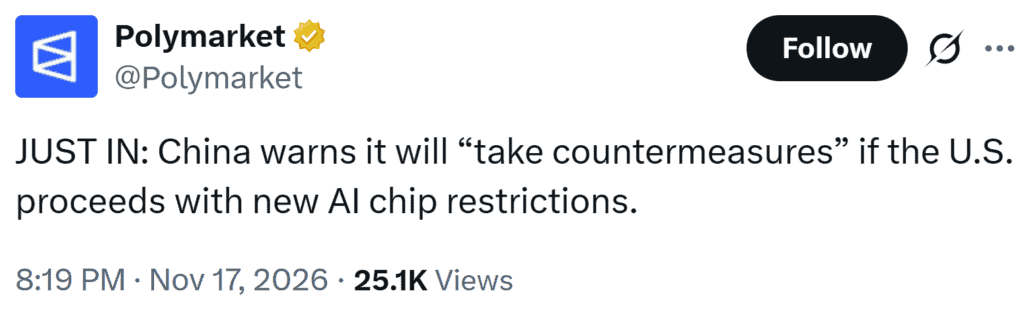
China warned it would take “necessary measures” and retaliatory action in response to the new US AI chip export restrictions. Source: @Polymarket/X
The ministry also called on Washington to return to the “correct track” of resolving differences through consultation and cooperation.
The response adds another layer of tension to the technology and trade relationship between the world’s two largest economies. The announcement also comes ahead of a planned meeting between US President Donald Trump and Chinese President Xi Jinping at the APEC summit in Shenzhen.
Meanwhile, US lawmakers are considering additional legislation to strengthen oversight of advanced semiconductor exports and address remote access to restricted computing resources.
Several proposals seek to expand congressional oversight of chip export licenses and improve tracking mechanisms to prevent advanced processors from reaching unauthorized destinations. These efforts could further shape US semiconductor policy in 2027.
A Polymarket prediction market placed the probability of a related AI chip export licensing bill becoming law in 2026 at 45%. The figure reflects traders’ expectations rather than an official legislative forecast or confirmed outcome.
Chinese AI Stocks Decline as Chip Access Concerns Grow
The latest restrictions have also weighed on investor sentiment toward China’s artificial intelligence sector.
Chinese technology stocks declined on November 17 as investors assessed the potential impact of tighter access to advanced computing infrastructure.
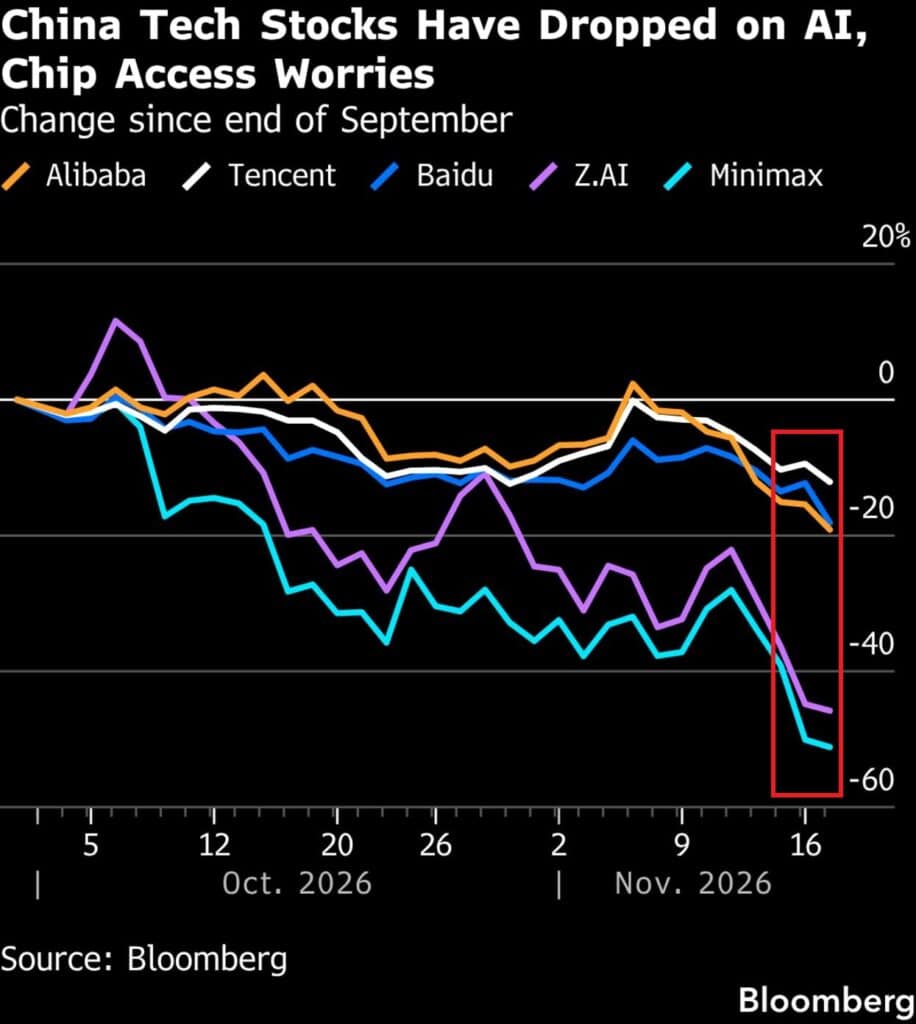
Bloomberg data shows mounting losses in major Chinese tech stocks, including Alibaba, Tencent, and Baidu, accelerating in mid-November amid AI computing access concerns. Source: @GlobalMktObserv/X
Alibaba shares fell approximately 5%, while Baidu declined 5.8% to a record low. AI model developers MiniMax and Z.AI also recorded losses exceeding 5%, while robotics company Yushu Technology dropped around 12%.
The declines contributed to a 1.1% fall in the Hang Seng Tech Index, reflecting concerns about the potential impact of US semiconductor restrictions on Chinese cloud providers and AI developers.
However, the market reaction was not uniform across the semiconductor industry. Chinese chipmakers Semiconductor Manufacturing International Corporation (SMIC) and Hua Hong Semiconductor gained as investors considered the possibility of increased demand for domestically produced chips.
The divergence highlights the potential consequences of tighter US export controls for China’s technology industry. While companies dependent on advanced foreign processors could face higher computing costs and infrastructure constraints, domestic semiconductor manufacturers may benefit from efforts to reduce reliance on overseas suppliers.
The latest restrictions therefore extend beyond Nvidia’s chip sales, potentially affecting cloud computing providers, AI developers, semiconductor manufacturers, and data center operators across multiple markets.
For Nvidia, the regulatory changes introduce additional compliance requirements for international customers and distribution partners. For China, they create another obstacle in securing the computing resources needed to develop increasingly sophisticated AI systems.
 Brave New Coin reaches 1M+ engaged crypto enthusiasts a month through our website, podcast, newsletters, and YouTube. Get your brand in front of key decision-makers and early adopters in 2026. Limited slots remaining! Find out more today!